

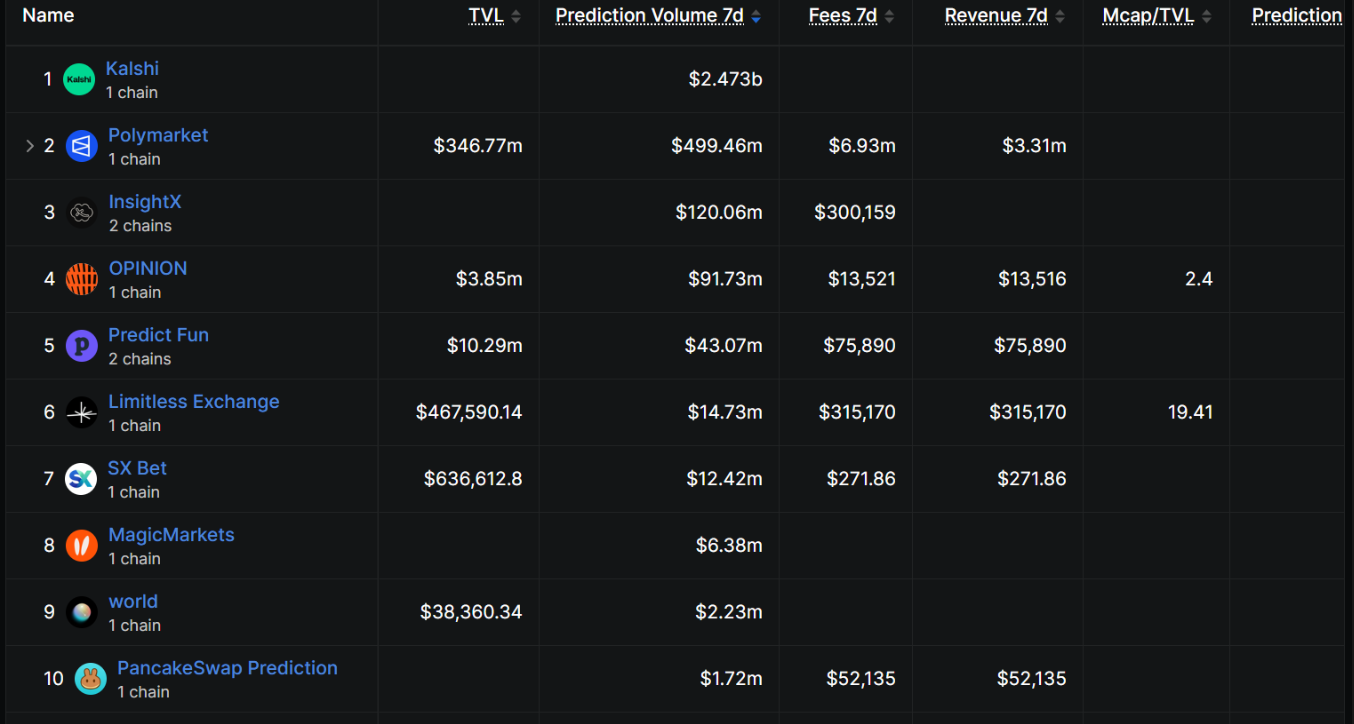
- Kalshi leads current volume with $2.47 billion traded over seven days.
- Polymarket follows at $499.46 million, while InsightX records $120.06 million.
- Sports drives the surge, while politics and crypto retain major platform shares.
Prediction markets are recording heavy trading while the broader cryptocurrency market stays under pressure. Bitcoin currently trades near $63,482, almost 50% below its October 2021 record above $126,000. Meanwhile, Kalshi, Polymarket International, and Polymarket US processed $44.8 billion during June, up 75% from May’s $25.66 billion.
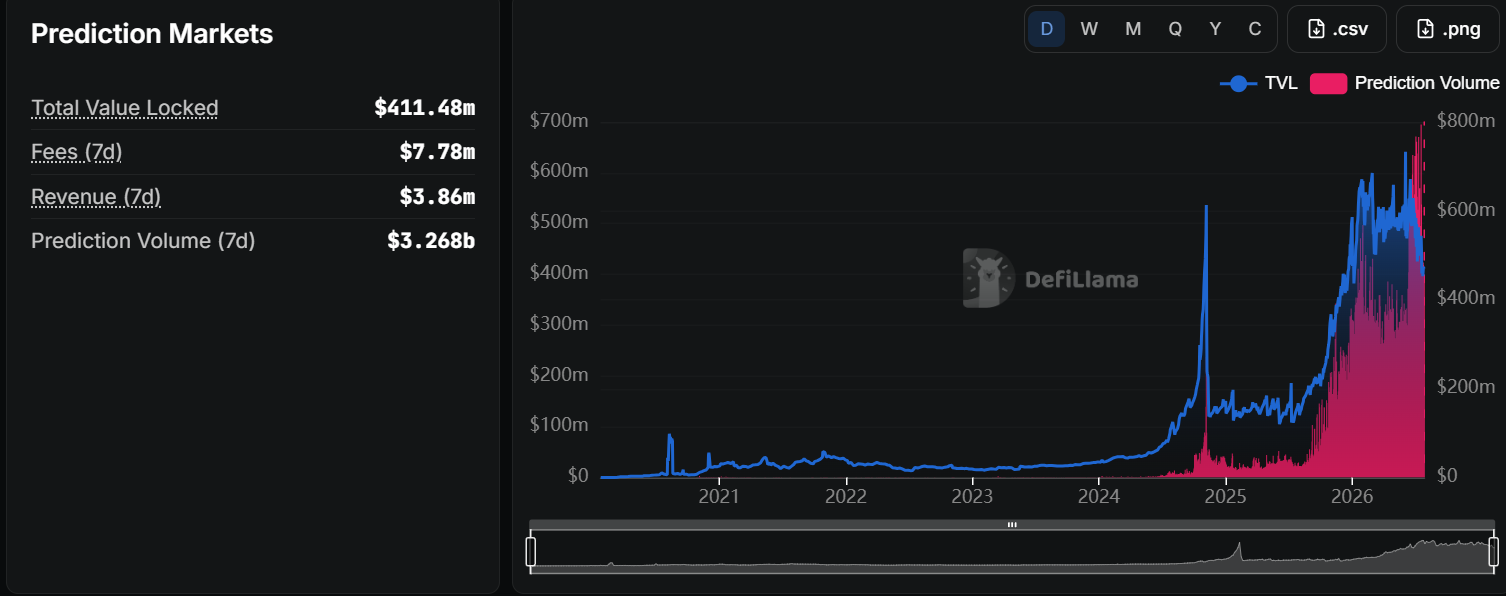
The latest DefiLlama data places seven-day prediction-market volume at $3.268 billion. Kalshi accounts for $2.473 billion, or about three-quarters of the total, while Polymarket contributes $499.46 million. The category also holds $407.77 million in total value locked, with $7.78 million in weekly fees and $3.86 million in revenue.
Kalshi Leads Current Trading Volume
Kalshi ranks first across both the latest 24-hour and seven-day data. Its daily prediction volume stands at $338.63 million, far above Polymarket’s $56.25 million. Over seven days, Kalshi records $2.473 billion, compared with $499.46 million for Polymarket.
That lead expanded during the 2026 FIFA World Cup. June data compiled by The Block placed Kalshi’s monthly volume at $31.5 billion, an 87.4% increase from $16.81 billion in May. Kalshi represented roughly 70% of the $44.8 billion recorded by the two Polymarket platforms and Kalshi.
Kalshi separately reported $27 billion in World Cup-related trading and attracted around 3 million users during the tournament. Its platform covers sports, political outcomes, cryptocurrency prices, economic releases, weather, culture, and company-related events.
Polymarket and Rothera Expand the Field
Meanwhile, Polymarket holds second place in DefiLlama’s current ranking. It records $499.46 million in seven-day prediction volume and $56.25 million over 24 hours. Its total value locked stands near $348.94 million, while weekly fees reach $6.93 million and revenue totals $3.31 million.
Polymarket International generated $10.26 billion during June, representing 45% monthly growth. Polymarket US added another $3.04 billion, taking their combined monthly total to about $13.3 billion.
Notably, the CFTC-regulated exchange said it had processed 3.5 billion traded contracts by mid-July after launching its first products on May 21. Its disclosure refers to contract count rather than dollar trading volume.
Rothera was established as a joint venture between Robinhood and Susquehanna International Group. Robinhood also distributes event contracts supplied by Kalshi, ForecastEx, and Rothera. Robinhood activity may therefore overlap with exchange-level figures and cannot be added as an independent venue without order-routing data.
Smaller Platforms Build Liquidity
More broadly, several smaller platforms are developing measurable trading activity behind the two market leaders. OPINION records $91.73 million over seven days and $21.01 million over 24 hours. InsightX posts a larger weekly total of $120.06 million, with daily volume at $13.82 million.
Predict Fun reports $43.07 million in weekly volume, followed by Limitless Exchange at $14.73 million and SX Bet at $12.42 million. MagicMarkets records $6.38 million, while World and PancakeSwap Prediction post $2.23 million and $1.72 million, respectively.
Other tracked venues include Overtime at $1.36 million, PredictStreet at $986,097, and Alpha Arcade at $435,904 over seven days. Myriad Markets and Sport. fun each recorded close to $300,000 during the same period.
Despite the growing number of platforms, liquidity remains concentrated. Kalshi and Polymarket together represent more than 90% of the $3.268 billion weekly volume shown in the DeFi Llama snapshot. InsightX, OPINION, and Predict Fun form the main group behind them.
Sports Drives Most of the Growth
Elsewhere, sports remains the largest trading category across the leading venues. Pew Research found that sports accounted for 80% of Kalshi’s global volume from July 2024 through early 2026. It represented 39% of Polymarket’s volume over the same period.
The World Cup accelerated that existing concentration. Combined Kalshi and Polymarket volume grew 75% in June, while Kalshi’s volume increased 87.4%. Polymarket International grew 45% as football contracts attracted trading throughout the tournament.
Politics carries a larger long-term share on Polymarket. Since July 2024, political markets have represented 32% of Polymarket volume and 4% of Kalshi volume. During October and November 2024, politics reached 90% of Kalshi trading and 65% of Polymarket activity as the US presidential election approached.
Crypto represents 20% of Polymarket’s historical volume and 7% of Kalshi’s. Altogether, sports, politics, and cryptocurrency account for 90% of Polymarket volume and 91% of Kalshi activity across the period examined by Pew.
Related: Why Crypto’s Settlement Rails Are Eyeing FX’s $100 Trillion Short-Dated Problem
Economics and Company Markets Stay Smaller
Additionally, economics, companies, weather, culture, and entertainment form smaller portions of overall trading. Kalshi offers economic contracts linked to inflation, unemployment, interest rates, and recession indicators. Its company markets cover subjects such as Tesla deliveries, streaming subscriber figures, and technology milestones.
Other markets track public statements, artificial intelligence models, legal decisions, and weather conditions. However, available public dashboards do not provide a standardized live growth rate covering each smaller category across Kalshi, Polymarket, Rothera, and Robinhood. Pew’s research groups these areas outside the three dominant categories and describes their combined share as small.
The current DefiLlama ranking uses prediction volume, while the $44.8 billion June record uses notional taker volume compiled by The Block. Notional volume counts contracts at their $1 settlement value rather than the price paid during each transaction. Contracts can also change hands several times, meaning trading volume measures turnover rather than unique capital deposited.
Disclaimer: The information presented in this article is for informational and educational purposes only. The article does not constitute financial advice or advice of any kind. Coin Edition is not responsible for any losses incurred as a result of the utilization of content, products, or services mentioned. Readers are advised to exercise caution before taking any action related to the company.