
- RWA tokens led July with a 10.7% median return.
- On-chain RWA value reached $36.83 billion across 38 networks.
- Agent payment tools now connect wallets, APIs, and stablecoins.
Two forces are giving Web3 a clearer economic role in 2026. Real-world assets connect blockchains with regulated investments. Meanwhile, AI agents turn software into active market participants with wallets and transaction authority.
CryptoRank’s July chart shows RWA tokens delivering a 10.7% median return, while AI tokens gained 3.3%. However, token returns track market performance rather than institutional or technical adoption. Notably, RWA.xyz’s July dashboard records $36.83 billion in distributed asset value across 38 networks. It also shows more than 1.36 million RWA holders.
RWAs Connect Web3 With Regulated Financial Assets
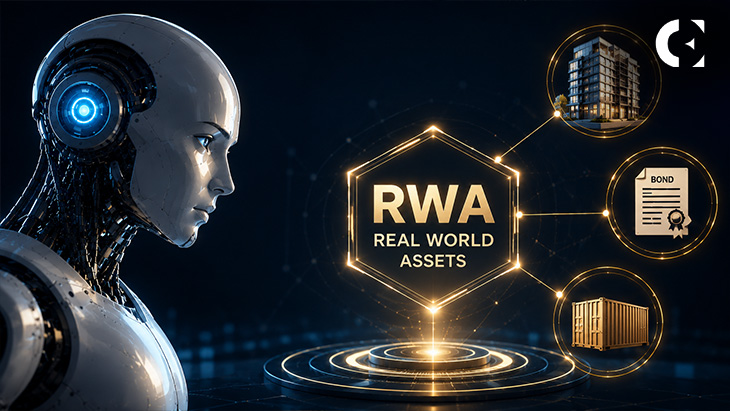
Real-world assets represent claims on investments originating outside blockchain networks. They include government bonds, money market funds, private credit, commodities, equities, and property. Issuers create tokens that track ownership rights, cash flows, or defined economic exposure.
Money market funds were one of the primary use cases for RWAs and are continuing to serve them. BlackRock issued the BUIDL, a tokenized institutional liquidity fund, on Ethereum via Securitize. Franklin Templeton records ownership of Benjamin money market fund shares on public blockchains.
Franklin reported $1.98 billion across the BENJI suite in April 2026. It also reported over $211 million in cumulative peer-to-peer transfers. Consequently, those figures connect blockchain records with a registered investment product and operating transfer agency system.
Moreover, sources have widened the category beyond tokenized Treasury products. Ondo Stocks crossed $1 billion in total value locked within eight months. The platform offered over 260 tokenized American stocks and exchange-traded funds across three networks.
Sources have also linked tokenization with established fund servicing. Its digital transfer agency connects blockchain activity with traditional ownership and transaction records. BNY expects both systems to operate together rather than replace each other immediately.
AI Agents Gain Wallets and Payment Authority
Meanwhile, AI agents are moving beyond chat interfaces and recommendation tools. An agent can plan tasks, call services, and execute several steps under programmed permissions. Web3 adds wallets, digital signatures, settlement, and portable records to that workflow.
On the other hand, Coinbase is enabling stablecoin payments through the x402 protocol, which operates over the standard web request mechanism. When a service wishes to demand a payment prior to giving out an endpoint or digital resource, it uses x402. An agent will sign off on the payment and submit proof, continuing to perform its other actions.
This was extended in March 2026 to enable payment with ERC-20 assets for agents, which means there is little to no swapping of assets by agents before payment is sent and also allows payments on more Ethereum networks.
Amazon has been involved in bringing such a model to enterprise development with its Bedrock AgentCore payments in preview since May 2026. Payment for APIs, website content, compute servers, and other agents is now enabled, and the first wallet connectors came from Coinbase and Stripe.
AgentCore has built-in controls for budgets per agent session and expiration controls, transaction history, and payment monitoring. Those tools address a key difference between human and machine spending. Software can operate continuously, so developers need enforceable limits around each wallet session.
Furthermore, draft ERC-8004 proposes registries for agent identity, reputation, and validation. It links blockchain identifiers with MCP, A2A, websites, wallets, and service endpoints. The proposal targets interactions between agents from separate organizations.
Leading Projects Cover Different Parts of Each Stack
Moreover, Virtual Protocol focuses on commerce between autonomous agents. Its Agent Commerce Protocol supports service discovery, job negotiation, work coordination, and payment settlement. Smart contracts can hold payments until buyers or evaluators approve completed work.
Virtuals reported 45,558 distinct agents and 1.48 million jobs over 30 days and $2.27 million in revenue during that period. Bittensor focuses on decentralized marketplaces for machine intelligence and digital assets.
Olas takes a different route through decentralized autonomous services. Its framework runs off-chain multi-agent systems secured through public blockchains. Developers can use those services for oracles, trading strategies, and continuous operations.
At the same time, Bittensor focuses on decentralized markets for machine intelligence and digital resources; it enables individual subnets to create any kind of service and be paid by the network with TAO tokens. This covers compute, data, models, and any other input an agent may request.
For the RWA side, Ondo, Franklin Templeton, BlackRock, and BNY cover different sections and functionalities of the tokenized market. Ondo works on tokenized securities and the opening of DeFi to them; Franklin and BlackRock are essentially giving a tokenized public representation of their funds.
Chainlink’s role, supplying decentralized oracle data to contracts and a bridge for tokenized assets between networks, is key, as blockchains can’t intrinsically know the market price or reservation price.
Related: RWA Tokens Top July Crypto Narratives as On-Chain Value Reaches $32.2B
RWAs Lead Deployment While Agents Change Access
Additionally, current deployments separate the two narratives by timing. RWAs already support regulated funds, tokenized stocks, collateral programs, and institutional settlement trials. AI agent commerce has working products, though several enterprise tools still carry preview labels.
Ondo completed a tokenized Treasury redemption with Kinexys, Mastercard, and Ripple in May. The pilot linked public blockchain infrastructure with cross-bank settlement rails. It processed the asset leg on the XRP Ledger in under five seconds.
Franklin Templeton also connected BENJI-issued money market shares with institutional trading infrastructure. Eligible Binance clients can use those shares as off-exchange collateral through Ceffu. Regulated custody holds the assets while they support trading activity.
By contrast, AWS describes agent payments as an early market with incomplete infrastructure. Its preview first targets micropayments for data, content, tools, and other agents. This stage differs from the regulated pools already operating through RWA platforms.
Therefore, current deployments place RWAs further along within Web3’s institutional financial layer. They connect existing securities, funds, and settlement processes with blockchain infrastructure. Legal structures and distribution channels already support those deployments.
AI agents occupy another layer of the emerging system. They can become interfaces that select services, move funds, and manage onchain workflows. Their reach depends on secure wallets, spending controls, identity standards, and reliable service discovery.
The two narratives already share settlement infrastructure. Agents use stablecoins for machine payments through x402-enabled services. RWA platforms also use stablecoins within subscriptions, redemptions, collateral, and institutional trading workflows.
For now, RWAs provide financial instruments entering Web3 at an institutional scale. AI agents provide a new method for accessing and coordinating those instruments. Their development tracks increasingly meet through wallets, stablecoins, data networks, and programmable settlement.
Disclaimer: The information presented in this article is for informational and educational purposes only. The article does not constitute financial advice or advice of any kind. Coin Edition is not responsible for any losses incurred as a result of the utilization of content, products, or services mentioned. Readers are advised to exercise caution before taking any action related to the company.