

- Hyperliquid is expanding beyond crypto trading into DeFi, commodities, and stock index markets.
- Analysts say HYPE has stayed strong despite Bitcoin weakness and slowing ETF inflows.
- Grayscale believes Hyperliquid could evolve into a major global financial platform.
Hyperliquid has become one of the most talked-about projects in crypto. Analysts and major firms now see it as something much bigger than a decentralized exchange, not just another high-volume trading platform.
The platform started as a decentralized perpetual futures exchange. Since then, it has expanded into prediction markets, synthetic assets, commodities, equities, and broader DeFi infrastructure. That expansion is attracting institutional attention beyond traditional crypto traders.
The discussion grew even stronger after digital asset manager Grayscale published a report arguing that Hyperliquid could evolve into a major financial services platform rather than remain just another crypto exchange.
HYPE Outperforming Despite Bitcoin Weakness
Market analysts have highlighted the strong performance of Hyperliquid’s native token, HYPE, even while Bitcoin struggled.
Analyst Alex Hunter noted that Bitcoin price action has remained weak since the launch of HYPE ETFs. Despite that, HYPE has continued to outperform, attracting more than $100 million in inflows since May 12.
However, Hunter also warned that inflows have begun to slow. The ETFs recorded just $3.4 million in net inflows two days ago, followed by another $1 million the next day. According to him, institutional demand will remain an important factor to watch, especially if Bitcoin continues trending lower.
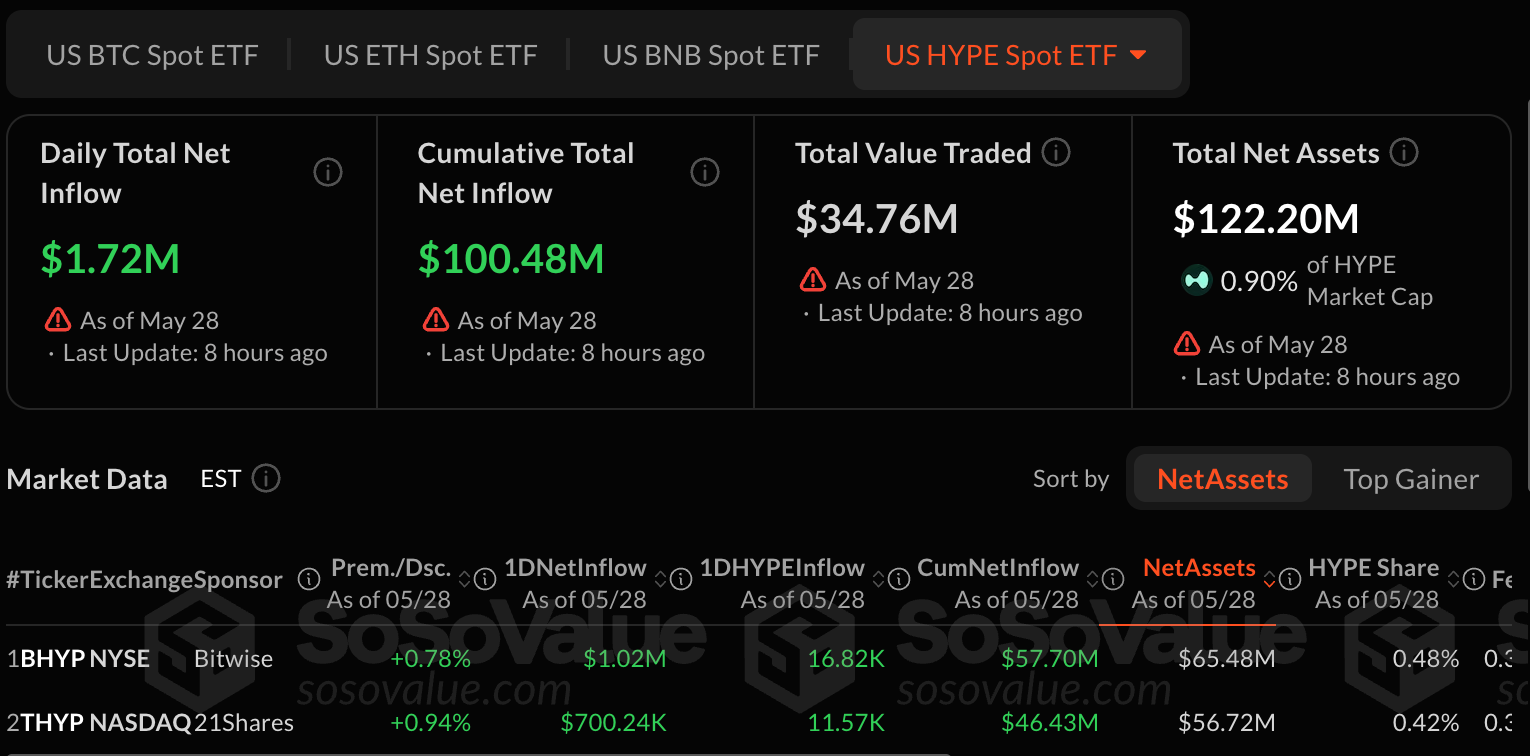
Hunter also pointed to recent activity involving Galaxy. The firm unstaked 1 million HYPE tokens worth around $60 million and transferred them to HyperEVM through an OTC-linked address. The address is believed to be connected to future Grayscale ETF activity.
Related: Is Hyperliquid the Next Financial Services Juggernaut?
Still, Hunter argued that these transfers should not be viewed as true market inflows because the tokens were already purchased months earlier. He said the move mainly reduces potential selling pressure instead of creating fresh buying demand.
Hyperliquid Expanding Beyond Perpetual Futures
Perpetual futures trading remains Hyperliquid’s core business, but the platform is rapidly expanding into more financial products.
The protocol now supports prediction markets, pre-IPO synthetic assets, and full DeFi functionality through HyperEVM. Analysts say this is helping Hyperliquid position itself as a complete financial infrastructure layer rather than a single-purpose trading app.
Hyperliquid Daily described the project as “the full financial layer” because of its expanding ecosystem and aggressive HYPE buyback model.
The platform currently routes about 99% of fees toward HYPE buybacks and token burns. This directly connects platform activity to the token’s economics.
According to Grayscale data, Hyperliquid generated roughly $800 million in annualized revenue while operating with a relatively small team. That level of efficiency has drawn comparisons to some of the world’s biggest fintech firms.
Institutional interest increased further after ICE CEO Jeffrey Sprecher described Hyperliquid’s impact as potentially “bigger than NASDAQ” in terms of market structure innovation.
The Core Technology Driving Growth
One reason Hyperliquid has gained traction is its ability to deliver a centralized exchange-like experience while remaining fully on-chain.
The platform offers deep liquidity, visible order books, fast execution speeds, and self-custody. Every trade, liquidation, and transaction is recorded on-chain, giving users more transparency than many centralized competitors.
Grayscale said Hyperliquid processed around $2.9 trillion in perpetual futures volume during 2025 and reached nearly $7 billion in open interest.
That performance pushed Hyperliquid into the top tier of global perpetual futures exchanges. This is notable because the platform is still less than three years old and continues blocking users in markets like the United States.
Its architecture also plays a major role in growth.
HyperCore powers the exchange infrastructure, including order books, liquidations, margin systems, and perpetual futures trading. HyperEVM gives developers an Ethereum-compatible environment for building applications connected to Hyperliquid liquidity. HyperBFT secures the network through delegated proof-of-stake consensus.
Unlike many crypto projects that adapt general-purpose blockchains for trading, Hyperliquid built its chain specifically for trading performance.
Commodities and Stock Indexes Trading Around the Clock
One of Hyperliquid’s biggest institutional attractions may be its expansion into non-crypto markets. Through its HIP-3 system, developers can launch perpetual futures tied to commodities, stock indexes, and other real-world assets.
These markets have already seen major trading activity.
Silver perpetual futures surpassed $4 billion in daily volume during a volatility spike in February. Oil perpetuals also crossed $4 billion in 24-hour volume during Middle East tensions in April. At one point, oil perpetual trading volume briefly exceeded Bitcoin perpetuals on the platform.
Hyperliquid has also introduced S&P 500 perpetual contracts that continue trading during weekends when traditional equity markets are closed.
This ability to offer continuous global price discovery is one reason some analysts believe the platform could eventually compete with parts of traditional financial infrastructure.
So far, HIP-3 markets have generated more than $230 billion in cumulative trading volume across over 140 active trading pairs.
Related: HYPE Targets $69 as Whales Double Down and Short Sellers Face Mounting Losses
Analysts Watching for Another Breakout
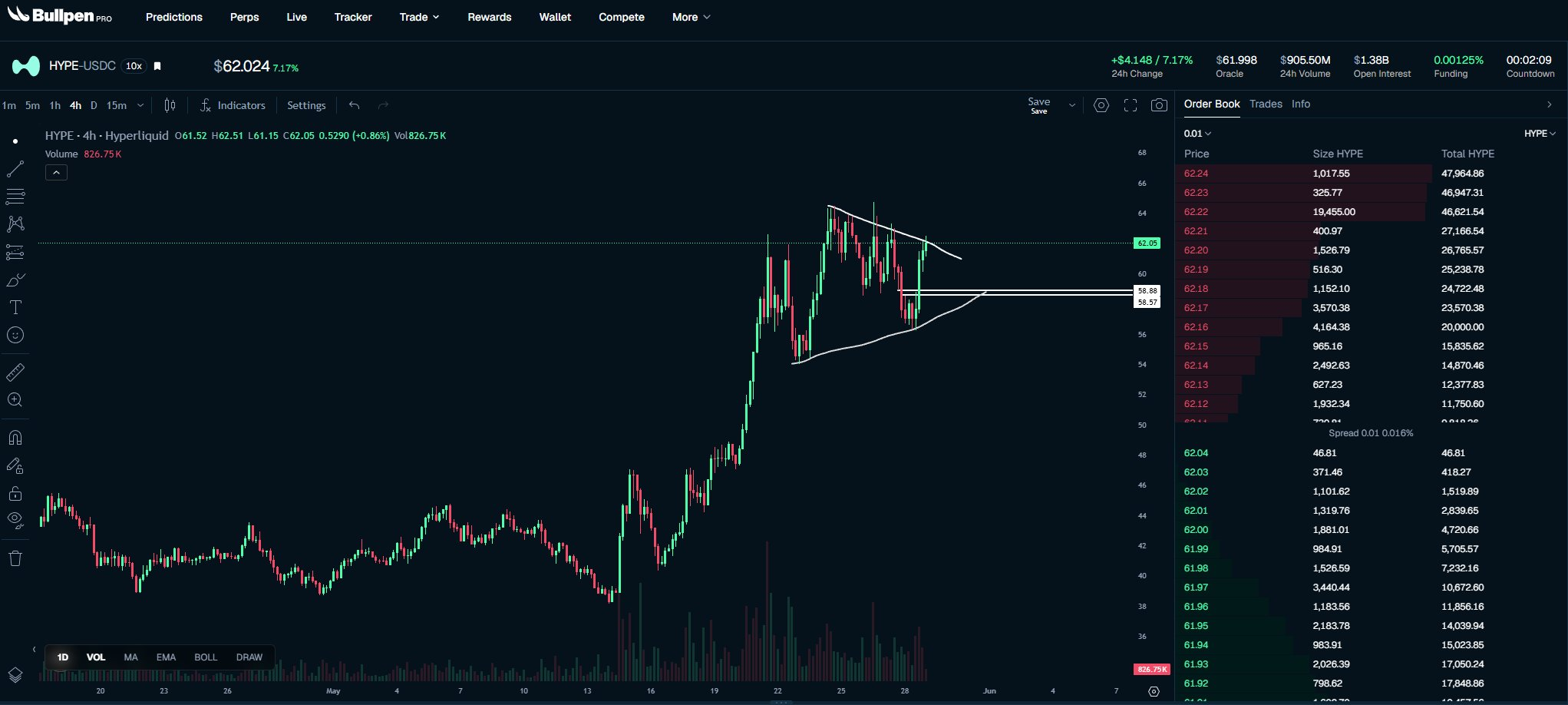
Market participants are also closely watching HYPE’s technical setup. Analyst Ansem said the token remains strong after rallying roughly 50% in one week. It is now consolidating near previous all-time highs.
He described the structure as a possible bull pennant and suggested a breakout could happen within the next two weeks.
According to Ansem, any short-term dip after monthly closes could become an opportunity for sidelined traders looking for entry positions. He also stated that he does not expect HYPE to revisit the $50 price level again.
Regulation Could Decide the Next Phase
Despite the optimism, regulation remains one of Hyperliquid’s biggest uncertainties. Perpetual futures products are still largely unavailable in the United States because they do not fit neatly within existing derivatives regulations.
As a result, Hyperliquid continues blocking U.S. users.
However, Grayscale argued that future regulatory clarity around decentralized exchanges and perpetual futures could significantly expand the platform’s addressable market.
The report pointed to growing industry involvement from firms like Coinbase, Kraken, Robinhood, and Kalshi. It also highlighted increasing discussions around perpetual futures regulation within the Commodity Futures Trading Commission.
If compliant perpetual futures trading eventually becomes allowed in the U.S., Hyperliquid could gain access to one of the world’s largest financial markets.
Risks Still Exist
Despite the rapid growth, analysts say risks remain substantial. HYPE remains highly volatile, with annualized volatility estimated near 80%. That is far higher than Bitcoin.
Grayscale also raised concerns about Hyperliquid’s relatively centralized validator structure and its closed-source software model. Both issues could worry decentralization advocates.
Regulation also remains a major long-term uncertainty. If U.S. access stays restricted, future expansion could become more difficult. Still, Hyperliquid has already achieved large-scale real-world usage combined with strong revenue generation.
That combination is why many investors no longer see Hyperliquid as just another crypto exchange. Instead, they view it as a possible blueprint for a new kind of global financial platform.
Disclaimer: The information presented in this article is for informational and educational purposes only. The article does not constitute financial advice or advice of any kind. Coin Edition is not responsible for any losses incurred as a result of the utilization of content, products, or services mentioned. Readers are advised to exercise caution before taking any action related to the company.