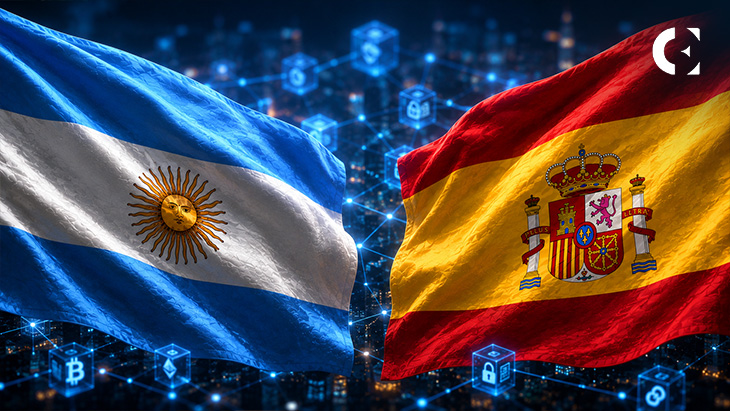
Argentina and Spain have built thriving crypto ecosystems through very different paths.
Argentina’s market grew out of economic instability, where digital assets became a tool for protecting savings and making payments. Meanwhile, Spain developed within the European Union’s regulated financial system, focusing on clear rules, institutional support, and long-term growth.
While both countries have embraced crypto, they excel in different areas. Comparing them side by side shows which nation has the advantage across the industry’s key pillars.
Crypto Adoption: Argentina Leads in Everyday Usage
Argentina has a stronger crypto adoption story. Digital assets are part of everyday financial life, not just an investment. Years of high inflation and the peso’s depreciation have pushed millions of Argentines toward cryptocurrencies, especially stablecoins, to preserve their purchasing power.
Between July 2024 and June 2025, the country processed around $91–94 billion in on-chain transaction volume, making it Latin America’s second-largest crypto market after Brazil. More than 10 million people actively use crypto wallets, and over 60% of transactions involve stablecoins.
Spain’s adoption is also impressive, but the motivation is different. Most people use crypto for investing and digital payments instead of replacing traditional money. More than 25 million users are expected by 2026, while the market is projected to grow from about $40 billion in 2024 to $92 billion by 2033. However, crypto remains an optional financial product rather than a necessity for most Spaniards.
Regulation: Spain Has the More Mature System
Spain clearly has the advantage when it comes to regulation. It follows the European Union’s Markets in Crypto-Assets (MiCA) rules, which give exchanges, token issuers, and crypto companies a single legal framework across all EU member states.
A company licensed in Spain can expand throughout the European Union, giving businesses regulatory certainty and access to a much larger market. Spain has also strengthened tax reporting and oversight, creating a predictable environment for large financial institutions.
Argentina has also made significant progress. It introduced a Virtual Asset Service Provider (VASP) registration system in 2024 that requires crypto businesses to register, follow anti-money laundering rules, and maintain transaction records. However, the system is still relatively new and continues to evolve alongside President Javier Milei’s broader economic reforms.
The two countries have different priorities. Spain focuses on long-term regulatory certainty, while Argentina is trying to balance oversight with innovation and economic liberalization.
Exchanges: Spain Wins on Scale, Argentina on Innovation
Both countries are home to leading global exchanges, including Binance, Coinbase, Kraken, and Bitget, so access to crypto markets is widely available.
Spain’s biggest advantage is market reach. Under MiCA, exchanges licensed in Spain can serve customers across the entire European Union. That gives them access to a much larger customer base than a license issued in a single country.
Meanwhile, Argentina is exploring new ways to integrate crypto into traditional finance. Authorities are considering rules that would allow commercial banks to offer crypto trading and custody services directly. If approved, this could make crypto much more accessible to everyday users.
For now, Spain offers greater scale and regulatory certainty, while Argentina stands out for its willingness to test new ideas.
Stablecoins: Argentina Is Far Ahead
Stablecoins highlight the biggest difference between the two ecosystems.
In Argentina, stablecoins have become an essential financial tool. USDT is widely used to protect savings from inflation and is accepted by some merchants through QR-code payments.
Policymakers have even discussed accepting stablecoins for certain municipal tax payments. Stablecoins are woven into everyday commerce rather than serving only as crypto assets.
Spain follows a different approach. Under MiCA, stablecoins must meet strict regulatory requirements before they can be widely offered.
Since Tether’s USDT is not MiCA-compliant, many regulated exchanges have removed USDT spot trading pairs for users in the European Economic Area. As a result, many users have shifted to alternatives such as USDC and EURC.
The reasons are straightforward. Argentines rely on stablecoins because they solve a real economic problem. In Spain, where the financial system is more stable, regulation plays a much bigger role in shaping the market.
CBDCs
Spain is well ahead in central bank digital currency development.
As part of the European Central Bank’s digital euro project, Spain is preparing for pilot testing that is expected to begin in 2027 if supporting legislation is approved. A full launch could follow around 2029. The project reflects a joint effort by financial institutions across Europe.
Argentina has discussed introducing a digital peso, but there is no official timeline or pilot program. Instead, the country’s crypto market has naturally developed around privately issued stablecoins.
The two countries are taking different approaches. Spain is building government-backed digital infrastructure, while Argentina has allowed market demand to drive digital currency adoption.
Web3 Startups
Argentina’s Web3 ecosystem is growing quickly, especially in fintech, remittances, and payment solutions designed for a population that already relies heavily on digital dollars. Lower living costs and improved regulations have also attracted developers and entrepreneurs.
Spain, however, offers a stronger environment for growing blockchain businesses. Companies benefit from access to the wider European market, deeper venture capital funding, and established innovation hubs in cities such as Barcelona and Madrid. The stability provided by MiCA also gives startups more confidence to build long-term products.
Argentina’s startup scene is highly innovative because it solves urgent financial problems. Spain, however, offers better conditions for companies looking to expand.
Verdict
Argentina and Spain represent two successful but very different crypto models.
Argentina leads in grassroots adoption, real-world crypto payments, and stablecoin use because digital assets have become a practical solution to everyday economic challenges. Few countries can match the extent to which crypto has become part of daily financial life.
Spain, however, has a stronger overall ecosystem. Clear regulations, access to the entire EU market, strong institutional support, a growing Web3 sector, and a clear digital euro roadmap give it a stronger foundation for long-term growth.
If the goal is measuring real-world crypto adoption, Argentina comes out on top. But when comparing the overall strength, scalability, and long-term sustainability of a national crypto ecosystem, Spain has the edge. Its combination of regulatory clarity, market access, and institutional support makes it a stronger crypto ecosystem overall.
Related: Argentina Sends Online Gambling and Crypto Payment Bill to Congress
Disclaimer: The information presented in this article is for informational and educational purposes only. The article does not constitute financial advice or advice of any kind. Coin Edition is not responsible for any losses incurred as a result of the utilization of content, products, or services mentioned. Readers are advised to exercise caution before taking any action related to the company.