

- Bitcoin fell from May 22 to May 23 and slipped below the ¥12 million level.
- The ARMA bill would create a Strategic Bitcoin Reserve, but reports said it lacks a firm 1 million BTC purchase mandate.
- Options data showed the put-call ratio rising to 100.62, pointing to stronger hedging demand.
Bitcoin entered the weekend under pressure after policy expectations cooled and market data showed heavier selling across spot and derivatives venues. The move pushed BTC below ¥12 million, a key psychological level for Japanese traders, while dollar-based charts showed price hovering near the mid-$75,000 zone.
Recent market data breaks down the Japanese market report, the ARMA disappointment, Trump Media-related transfer concerns, and the warning signs appearing in futures and options data as traders watch the next U.S. macro and crypto policy dates.
Policy Hopes Fade as Bitcoin Slides
Bitcoin fell between May 22 and the morning of May 23, with CoinPost’s market chart showing BTC near $75,378 after touching around $75,133. Price moved steadily lower from the $78,000 region as sell pressure built through the session.
A key trigger came from the new U.S. Bitcoin reserve discussion. Representative Nick Begich introduced the American Reserve Modernization Act, known as ARMA, alongside co-lead Jared Golden. The bill seeks to establish a formal Strategic Bitcoin Reserve and modernize federal digital asset management.
However, the Japanese report said traders had expected stronger language, including a clear obligation for the government to buy 1 million BTC. That expectation faded after the draft appeared to focus more on long-term treatment of government-held Bitcoin and on a budget-neutral approach. A separate report said the proposal dropped a direct 1 million BTC purchase target, which helped drive disappointment selling.
Meanwhile, another pressure point came from Trump Media and Technology Group. Recent reports said the company transferred 2,650 BTC, worth about $205 million, to Crypto.com, while stating that it had not sold the coins. The transfer still increased market caution, especially as traders were already watching large corporate Bitcoin holders.
Regulatory expectations also weakened. The Japanese report noted that uncertainty remains around the CLARITY Act even after progress in the Senate Banking Committee. The bill still faces ethics debates and full Senate procedures, with Democrats raising conflict-of-interest concerns tied to Trump-linked crypto activity. That uncertainty weighed on broader policy optimism.
Related: Bitcoin Mortgage Push Gains Ground as Crypto Enters U.S. Housing Market
Spot and Futures Charts Show Sell Pressure
Market structure confirmed the weaker mood. CoinPost’s buy-versus-sell chart showed repeated sell-side pressure across both spot and derivatives markets during the May 22 to May 23 session. Red bars dominated several stretches, especially after the evening selloff.
Spot sell pressure was visible first, but derivatives followed with heavier selling bursts. That matters because weakness in both markets often reflects broader risk reduction, not only short-term futures positioning.
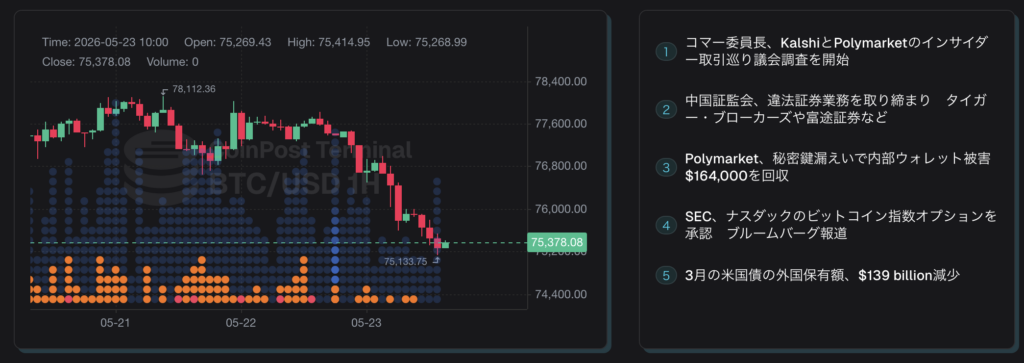
The CoinPost Terminal chart also showed BTC drifting lower in a controlled but persistent pattern. Price failed to hold the $77,000 area, then slid toward $76,000 before testing the low-$75,000 range. The chart’s heatmap suggested liquidity clustered below recent candles, with BTC near $75,378 at the latest data.
CME positioning added another caution signal. The COT chart showed open interest easing from earlier May levels. A decline in CME open interest can suggest that institutional participants are trimming exposure or reducing fresh risk before major events.
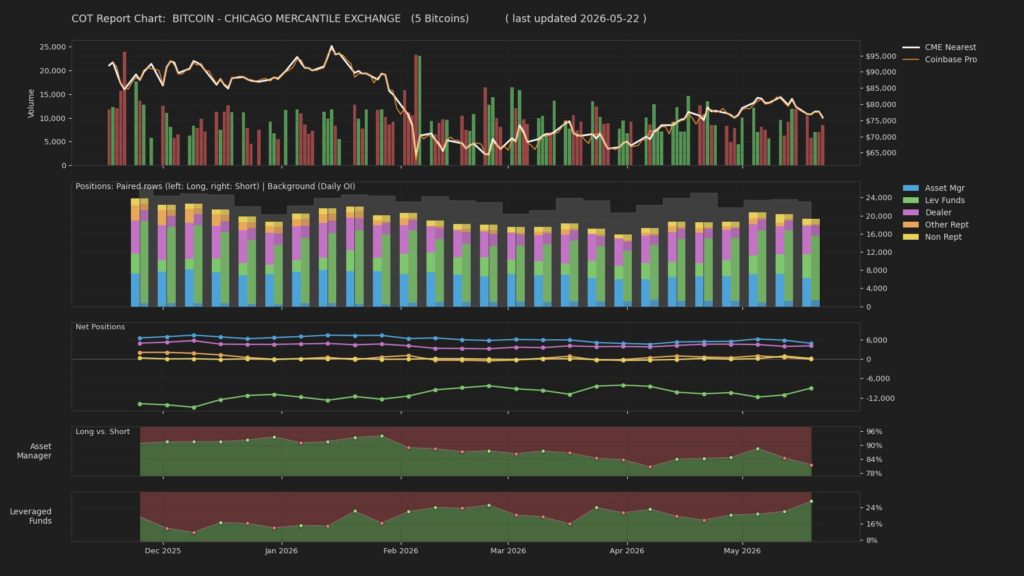
Net-position panels also showed leveraged funds still carrying a larger short-side profile than asset managers. Asset managers remained more long-biased, but the long-versus-short percentage weakened from earlier levels. Leveraged funds, meanwhile, showed a rising short share into late May.
That mix points to a market where long-term allocators have not fully exited, but active and leveraged traders are becoming more defensive. It also helps explain why Bitcoin struggled to defend the $76,000 to $77,000 zone after the policy disappointment.
Related: Bitcoin Price Prediction: US Government Locks Its BTC for 20 Years as ETFs Bleed Six Days
Options Traders Add Downside Protection
Options data showed the clearest shift in risk management. Deribit BTC options open interest showed BTC near $75,384, with call open interest at 232,340 and put open interest at 158,621. The put-call ratio rose to 100.62, up 4%, showing stronger demand for downside protection.
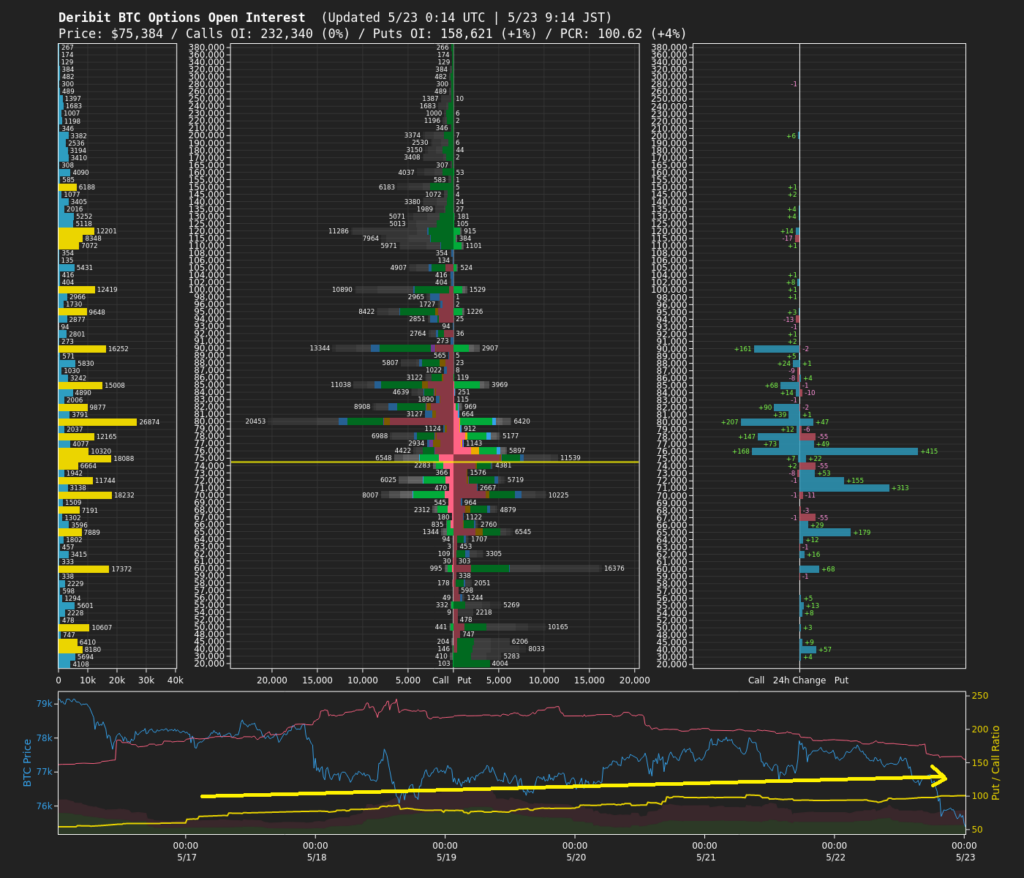
The chart showed notable open interest near the $75,000 strike, where the price was trading, and heavy activity around nearby downside levels. Demand increased as spot price fell, suggesting that traders were hedging against a deeper move rather than chasing upside.
Call interest remained larger in absolute terms, but the rising put-call ratio showed a change in tone. Traders were no longer positioned only for a policy-driven rally. Instead, they were paying more attention to downside risk before the next set of catalysts.
Near-term dates now matter. The Japanese report highlighted the June 1 ISM manufacturing index, the June 5 U.S. jobs report, and the second week of June for the expected Senate CLARITY Act debate. These events may affect rate expectations, risk appetite, and crypto policy sentiment.
For Bitcoin, the technical zone is now narrow. Holding the $75,000 area may stabilize the market after the latest disappointment. A break below that region would expose lower liquidity and could strengthen the defensive options trade.
A recovery to $76,800-$77,000 would ease immediate pressure, but Bitcoin likely needs stronger policy clarity or macro support to regain momentum. For now, the charts show a market that has moved from reserve-bill optimism into caution, with spot sellers active, CME exposure cooling, and options traders adding protection.
Disclaimer: The information presented in this article is for informational and educational purposes only. The article does not constitute financial advice or advice of any kind. Coin Edition is not responsible for any losses incurred as a result of the utilization of content, products, or services mentioned. Readers are advised to exercise caution before taking any action related to the company.