

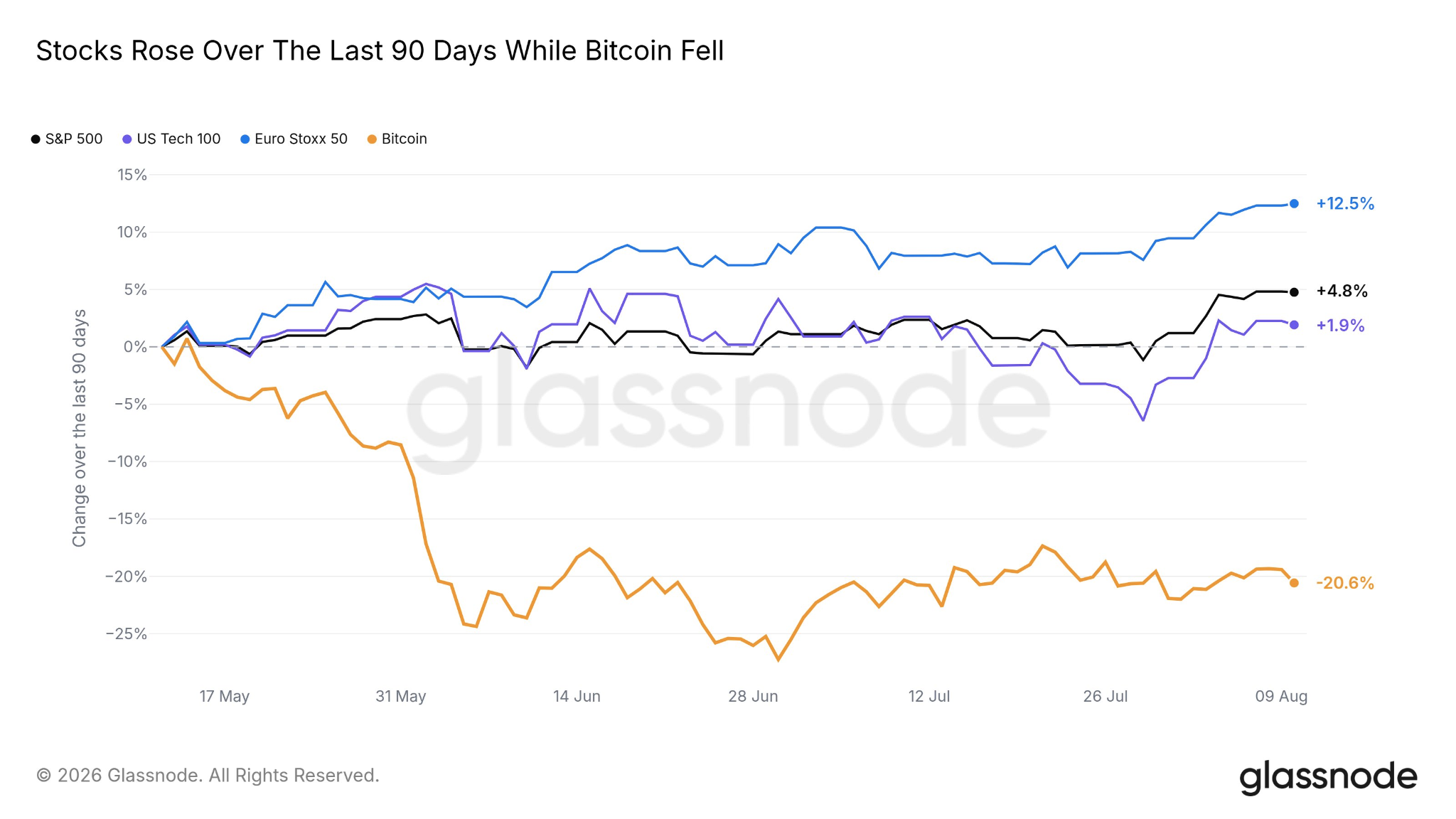
- Bitcoin fell 20.6% while the S&P 500 gained 4.8% over 90 days.
- Bitcoin’s divergence from equities echoes patterns seen near past cycle lows.
- CPI and PPI data could determine whether Bitcoin narrows its performance gap.
Bitcoin has fallen roughly 20% over the past 90 days while the S&P 500 has gained about 5%, according to Glassnode data, creating a gap between the cryptocurrency and U.S. equities. The divergence has left Bitcoin trading near $64,000 as stocks remain close to record levels.
The move stands out because Bitcoin and major equity indexes have previously shown stronger alignment during periods of changing liquidity and risk demand. With U.S. CPI and PPI data ahead, markets now have a near-term test of whether Bitcoin can narrow the gap or whether its weakness signals risks that equities have not yet priced in.
Bitcoin Underperforms Major Equity Indexes
Glassnode’s 90-day data shows Bitcoin down by 20.6%, compared with a 4.8% gain for the S&P 500. The US Tech 100 rose 12.5%, while the Euro Stoxx 50 advanced by 1.9% during the same period.
Source: X
Glassnode described the market as an “equity-led tape” and said Bitcoin would need to regain strength relative to major indexes for that pattern to change.
In addition, the current Bitcoin-equity divergence also resembles patterns observed around previous Bitcoin cycle lows. A similar pattern, reported by Dark Firest, a crypto analyst, emerged in March 2026, when he noted that Bitcoin had experienced its longest period of decoupling from the S&P 500 since 2020.
Nearly 70,000 BTC in open interest was wiped out in a single session, while equities remained comparatively resilient. The liquidation reduced leveraged positions and weakened Bitcoin’s market structure.
CPI and PPI Could Test Bitcoin’s Divergence
Attention now shifts to U.S. inflation data. Justin Bennett highlighted CPI and PPI, which is to take place this week, as important near-term indicators for the S&P 500 and Bitcoin, noting that recent inflation readings will help markets assess whether lower inflation signals a new trend or an isolated result.
Lower inflation could strengthen expectations for less restrictive monetary policy and potentially give Bitcoin room to recover some of its relative losses. A higher reading could add downward pressure on Bitcoin if markets expect stricter policy conditions to persist.
The upcoming CPI and PPI releases, therefore, provide a near-term test for the Bitcoin-equity gap. Bitcoin could begin catching up with stocks if inflation supports positive market conditions, while continued weakness could mean that crypto markets are at risk that equities have yet to face.
However, according to 10x Research report, Bitcoin may be breaking away from its S&P 500 correlation. The firm added that weaker summer jobs data could lead to a September Fed rate cut, potentially supporting Bitcoin and gold. It also noted that four Fed policymakers favored holding rates steady in July, making a sudden shift toward rate hikes less likely.
Related: Bitcoin Bottom Signal? S&P 500/BTC Ratio Recreates Rare Pattern Seen at Three Cycle Lows
Disclaimer: The information presented in this article is for informational and educational purposes only. The article does not constitute financial advice or advice of any kind. Coin Edition is not responsible for any losses incurred as a result of the utilization of content, products, or services mentioned. Readers are advised to exercise caution before taking any action related to the company.