

- QNT surged 323% in a week as banks expanded their use of blockchain infrastructure.
- The Clearing House selected Quant for its On-Chain Money Initiative, targeting tokenized bank deposits.
- UK banks also completed real customer transactions using Quant’s tokenized deposit infrastructure.
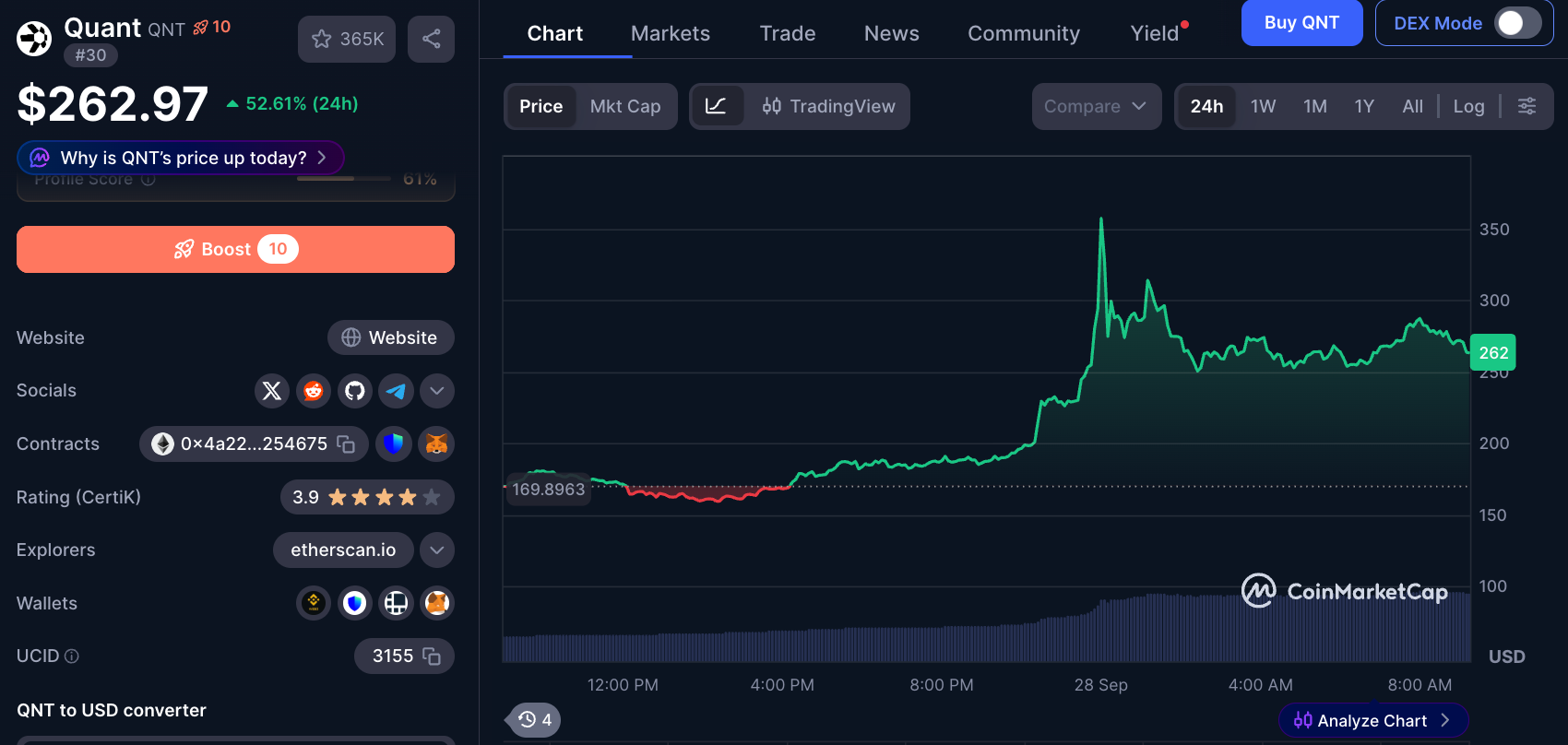
Quant’s QNT token has recorded a huge price increase amid the ongoing bull market and a new partnership with The Clearing House (TCH).
According to CoinMarketCap, QNT reached $277.56 after rising more than 50% in 24 hours and 323% in one week. It briefly reached $357 before falling back. Its previous all-time high was $428 in September 2021. With the ongoing spectacular price move, many believe reclaiming the five-year all-time high is within reach.
The Clearing House Deal
One of the biggest reasons for the rally is The Clearing House’s September 24 announcement that it selected Quant for its On-Chain Money Initiative.
The project aims to create a payments network that supports tokenized bank deposits. In simple terms, banks represent traditional deposits as digital tokens and move them on the blockchain.
The Clearing House plans to use Quant’s technology to connect different banks while also working with existing payment systems such as RTP and CHIPS. The system will become available to participating institutions in the first half of 2027. This initiative gives Quanta a role in a real institutional project, not a blockchain experiment.
UK Banks Are Also Testing Tokenized Deposits
Meanwhile, Quant is also involved in a similar project in the UK. Seven major banks — Barclays, HSBC UK, Lloyds Banking Group, Monzo, Nationwide, NatWest, and Santander — have completed real customer transactions using tokenized British-pound deposits.
The project is called the Great British Tokenised Deposit (GBTD) initiative. Quant provided the shared infrastructure, while EY helped manage the project and Linklaters provided legal support.
The early transactions included mortgage completions and a consumer payment. Notably, the technology automatically holds and releases money when certain conditions are met.
Why Quant’s Technology Matters
One of the biggest problems with blockchain adoption by banks is that banks use different systems. For example, one bank might issue digital deposits on one network while another bank uses a completely different system. Those networks need a way to communicate.
Quant is addressing this problem through interoperability and transaction orchestration. This allows banks to use blockchain without completely replacing their existing financial systems.
Will Bank Adoption Increase QNT’s Value?
Quant’s technology and partnerships can expand without creating the same level of demand for QNT.
If transaction activity grows but banks do not need to buy or use large amounts of QNT, the growth of Quant’s technology will not translate directly into higher demand for the token.
The Clearing House deal is important because it confirms Quant’s role as an infrastructure provider, but it does not establish that banks must use QNT to settle payments.
Institutional adoption therefore provides positive evidence for Quant’s technology. Its effect on QNT’s long-term value may depend more heavily on market and community sentiment.
Speculation Is Also Driving the Rally
The size of QNT’s price increase shows that speculation is playing a role. A 323% weekly gain attracts traders looking to profit from short-term price movements. QNT’s move from $357 back to $277.56 shows how volatile the rally has been.
Now, the key question is what happens after the initial excitement fades.
In sum, Quant has gained attention because of two important developments, and investors are also pricing in expectations about future adoption ahead of the planned 2027 U.S. rollout. But the long-term question is whether use of Quant’s technology will also create real demand for QNT.
Disclaimer: The information presented in this article is for informational and educational purposes only. The article does not constitute financial advice or advice of any kind. Coin Edition is not responsible for any losses incurred as a result of the utilization of content, products, or services mentioned. Readers are advised to exercise caution before taking any action related to the company.