

Satoshi Nakamoto leads Arkham’s 2026 Bitcoin ranking, with nearly 1.1 million BTC attributed to the creator’s wallets. Strategy tops public corporate holders, but the broader ranking includes exchanges and funds holding vast sums on behalf of customers and investors.
Arkham’s review places these entities within a single ranking, though the categories are not directly comparable. Wallet labels capture attributed ownership, whereas corporate filings and fund reports point to economic exposure.
Satoshi’s Estimated Holdings Lead the Ranking
An estimated 1.096 million BTC is attributed to a wallet group identified by Arkham as belonging to Bitcoin’s creator. According to a February 2025 announcement, the firm added 22,000 addresses to that group.
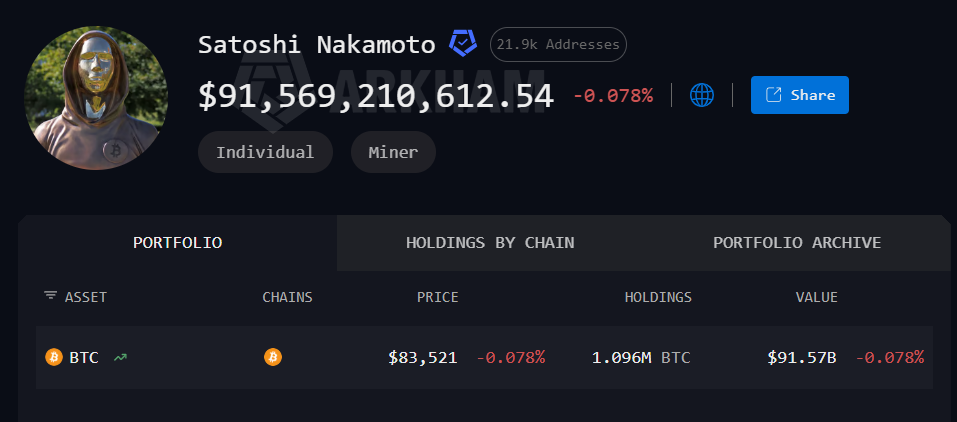
Researchers linked those addresses through the Patoshi Pattern, a pattern in early mining activity. Attribution based on that pattern remains distinct from proof of identity.
Neither the estimate nor the wallet labels establish who currently has the private keys. Access to those keys determines whether the coins can be spent. Satoshi therefore leads the reported attribution ranking, without confirmed evidence of present control over the entire balance.
Strategy Leads Public Corporate Bitcoin Treasuries
Strategy’s September 28 filing reported 847,666 BTC as of September 27. During the preceding week, the company acquired 1,665 BTC for $142.7 million.
Purchases averaged $85,681 per coin, including fees and expenses. Across its holdings, the reported acquisition cost reached $63.95 billion. Average purchase cost stood at $75,437 per BTC.
Corporate ownership explains Strategy’s place in the ranking. Shareholders own securities in the business, while the company reports the Bitcoin as treasury assets.
Measured against Bitcoin’s 21 million supply limit, Strategy’s holdings represent about 4.04%. Accumulation began in August 2020, when the company was still known as MicroStrategy.
Custody arrangements complicate the on-chain comparison. Part of Strategy’s holdings sits with Fidelity Custody, according to Arkham. Consequently, a wallet label alone does not capture the full company balance disclosed in its filing.
Coinbase and Binance Hold Bitcoin for Customers
Coinbase topped Arkham’s exchange category with about 969,000 BTC in its September 28 review. Binance followed with roughly 714,000 BTC. Fidelity Custody appeared separately with around 436,000 BTC.
For Coinbase, those tracked balances differ sharply from its own investment holdings. Coinbase’s June 30 SEC filing reported 17,311 BTC held for investment and 553 BTC for operations. Both categories describe company assets rather than its full customer custody business.
Binance’s reserve methodology states that covered funds are held in custody for users. Customer deposits therefore contribute to the exchange’s large wallet balances.
Reserve reports compare custodial assets with customer liabilities. Users can check their inclusion in Binance’s reported balances through its verification system.
On-chain checks found 248,597.59 BTC in its largest address, beginning “34xp4.” Blockchain.com and Blockstream returned matching figures on September 29 UTC. That address also topped the BitInfoCharts rich list, although its pooled holdings do not represent one investor’s wealth.
IBIT’s Bitcoin Belongs to the Trust
BlackRock’s holdings file listed 800,535.29 BTC for the iShares Bitcoin Trust ETF on September 28. This exceeds the rounded 799,000 BTC shown in Arkham’s review.
Under IBIT’s SEC filing, shares represent fractional beneficial interests in the trust’s net assets. A custodian holds the underlying coins on the trust’s behalf.
Describing that balance as BlackRock’s corporate Bitcoin reserve would misstate the ownership structure. Bitcoin is held on behalf of the iShares Bitcoin Trust, while IBIT shareholders own fractional beneficial interests in the trust’s net assets.
U.S. Bitcoin Seizures Carry Legal Conditions
Federal wallets held about 325,000 BTC in Arkham’s September 28 estimate. Enforcement cases account for the holdings described in that review.
One address labelled for the Bitfinex hack recovery contained 94,643.49 BTC. Independent checks through both blockchain explorers confirmed that balance. Verification of this address does not establish the full government total.
Government custody also differs from unrestricted reserve ownership. The March 2025 executive order covers eligible, finally forfeited Bitcoin and preserves other legal requirements. Identifiable victims remain eligible for asset returns under its provisions.
Tether’s Reserve Address Shows a Defined Balance
Tether’s tracked reserve address held 96,932.41 BTC as of September 28. Beyond that address, the company’s accounting records provide ownership context. Tether International’s June 30 reserve report identifies reserve assets as company-owned and records token liabilities as redemption obligations.
Those liabilities do not give token holders direct ownership of particular reserve coins. Separately, a single address cannot establish the full holdings of every company within the Tether group.
Unknown Wallets Keep Ownership Rankings Incomplete
Another address, beginning “bc1qd4,” held 91,850.12 BTC in matching blockchain checks. Analysts listed it without a named owner in Arkham’s review. Public transaction records establish the balance, but further evidence is needed to identify its beneficiary.
Large Bitcoin holdings give investors or custodians no automatic authority over the network’s rules. Protocol changes still rely on broader adoption across the ecosystem, keeping coin ownership separate from Bitcoin’s consensus process.
Related: Bitcoin Prices Diverge Across WazirX, CoinDCX, and CoinSwitch: Here’s Why
Disclaimer: The information presented in this article is for informational and educational purposes only. The article does not constitute financial advice or advice of any kind. Coin Edition is not responsible for any losses incurred as a result of the utilization of content, products, or services mentioned. Readers are advised to exercise caution before taking any action related to the company.