

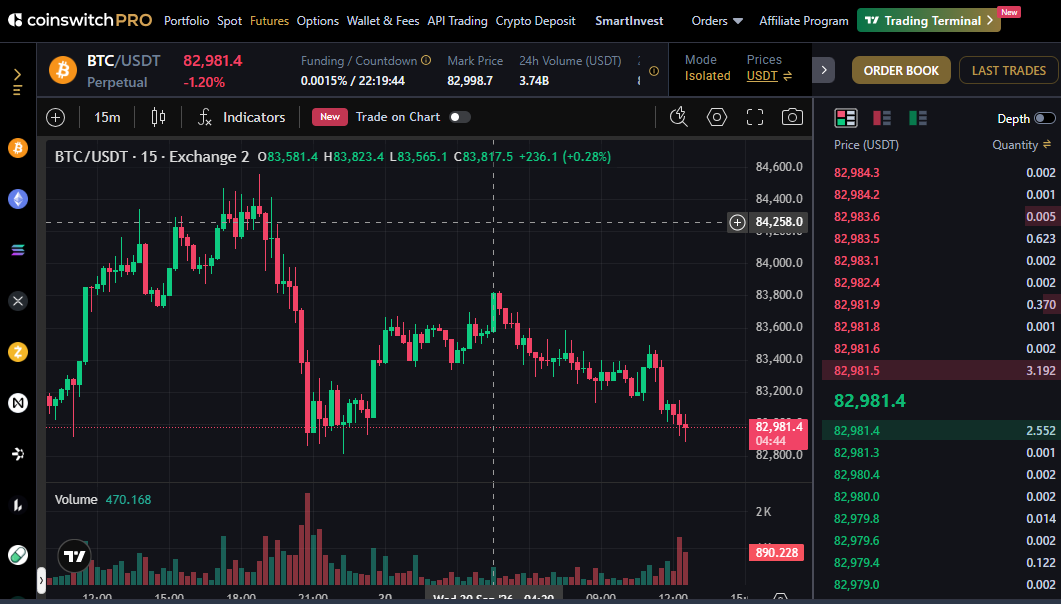
- BTC prices differ, trading at $83,198 on WazirX, $83,038.80 on CoinDCX, and $82,981.4 on CoinSwitch.
- Order books across Indian exchanges operate in separate liquidity pools with no unified order routing.
- Price gaps may persist until exchanges consolidate liquidity or introduce cross-exchange order routing.
Bitcoin does not trade at a single global price, and in India these differences are more pronounced across exchanges.
On September 30, 2026, Bitcoin spot prices on exchanges like WazirX, CoinDCX, and CoinSwitch are showing wide variations as thin liquidity and low trading volumes widen BTC price spreads. The gaps highlight how fragmented order books can create arbitrage opportunities for traders.
Why Bitcoin Prices Are Diverging Across WazirX, CoinDCX, and CoinSwitch
Bitcoin does not trade at a single global price. Every exchange has its own order book and matches the local buyer to the local seller in real time. This creates spreads that can be seen on Indian platforms for the same asset.
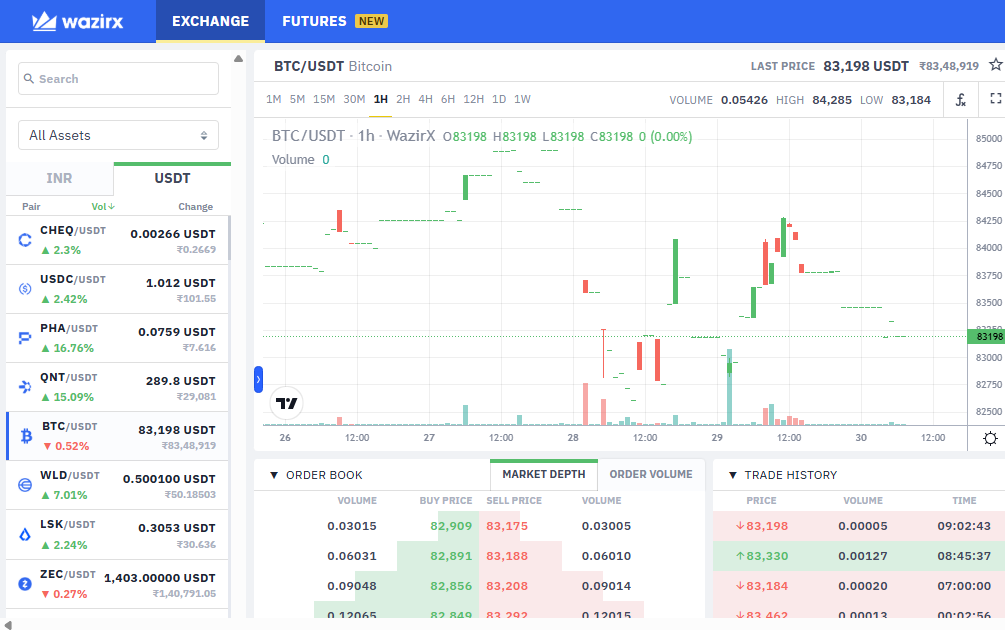
At press time, Bitcoin was trading at about $83,198 on WazirX, $83,038.80 on CoinDCX, and $82,981.40 on CoinSwitch. This clearly shows price gaps of about $150 to $220 between the highest and lowest. Even though these gaps may seem to be small in percentage terms, they are meaningful for active traders.
Moreover, these variations occur mainly due to thin liquidity and low trading volume. The Indian crypto markets are still fragmented in comparison with the global exchanges like Binance or Coinbase. WazirX, CoinDCX and CoinSwitch have a shallower order-book depth, particularly outside Indian trading hours.
When a relatively large buy or sell order hits a thin book, the price moves more sharply on that platform than on deeper global books. Lower trading activity reduces the number of resting limit orders near the mid-price, widening bid-ask spreads and prolonging temporary imbalances.
How Thin Liquidity and Low Trading Volume Widen BTC Price Gaps
On Indian exchanges, the order books of BTC/INR and BTC/USDT are significantly shallower. With fewer resting orders, even a moderately sized market buy or sell can eat through several price levels, resulting in a more dramatic move of the last-traded price higher or lower.
Low trading volume adds to the issue. Less continuous activity leads to greater bid-ask spreads and longer time intervals between significant trades. In cases of low volume, the final price traded may not reflect the global price action, or it may be overreacting to local order flow.
These dynamics create persistent micro-gaps. For instance, if WazirX has more buying pressure compared to CoinSwitch, then WazirX’s low-volume book will show higher prices till the time when some fresh buyers or arbitrage money comes in. The reverse occurs on the sell side.
Also, Indian market sizes are small compared to the international markets, and transfers between platforms incur fees, network confirmation delays, and a 1% TDS applied in India, which slows the arbitrage force. Gaps will thus persist for a longer period and occur more often in less liquid markets.
How Arbitrage Traders Exploit Bitcoin Price Differences
Arbitrage traders profit from the temporary price gaps that appear across exchanges by buying Bitcoin where it is cheaper and selling it where it is more expensive. When a clear spread exists, such as Bitcoin trading near $82,981 on CoinSwitch and $83,198 on WazirX, traders can buy BTC on the lower-priced exchange, withdraw it, deposit it on the higher-priced exchange, and sell.
What Does This Mean for Indian BTC Traders?
For Indian Bitcoin traders, these price gaps may continue as long as liquidity and trading volumes remain lower than global markets or until exchanges introduce shared liquidity or cross-exchange routing.
While these differences can create arbitrage opportunities, they are not risk-free. Traders must account for transaction fees, transfer delays, and India’s 1% TDS, all of which can reduce or eliminate potential profits.
As a result, price discovery in India remains fragmented. Traders need to compare prices across platforms, calculate net costs carefully, and size positions based on available liquidity rather than assuming a single uniform market price.
Related: Why Indian Crypto Users Rely on Stablecoins More Than on Bitcoin Exposure
Disclaimer: The information presented in this article is for informational and educational purposes only. The article does not constitute financial advice or advice of any kind. Coin Edition is not responsible for any losses incurred as a result of the utilization of content, products, or services mentioned. Readers are advised to exercise caution before taking any action related to the company.