

- ARB mentions rose in two waves as legal actions drove renewed focus on Arbitrum’s frozen funds.
- Court intervention halted DAO plans, shifting control of $71M in Ether away from on-chain governance.
- The dispute highlights rising tension between DeFi systems and traditional legal enforcement.
Market attention snapped back to Arbitrum after its ARB token saw a fresh spike in online discussions. Santiment Intelligence data shows activity rising again as new legal details emerged around frozen funds. The shift followed a U.S. court order blocking the movement of about $71 million in Ether linked to a recent exploit.
As a result, traders and DeFi participants quickly returned to the story as its implications became clearer. The situation now brings together legal action, DAO governance, and recovery efforts in a single high-stakes dispute.
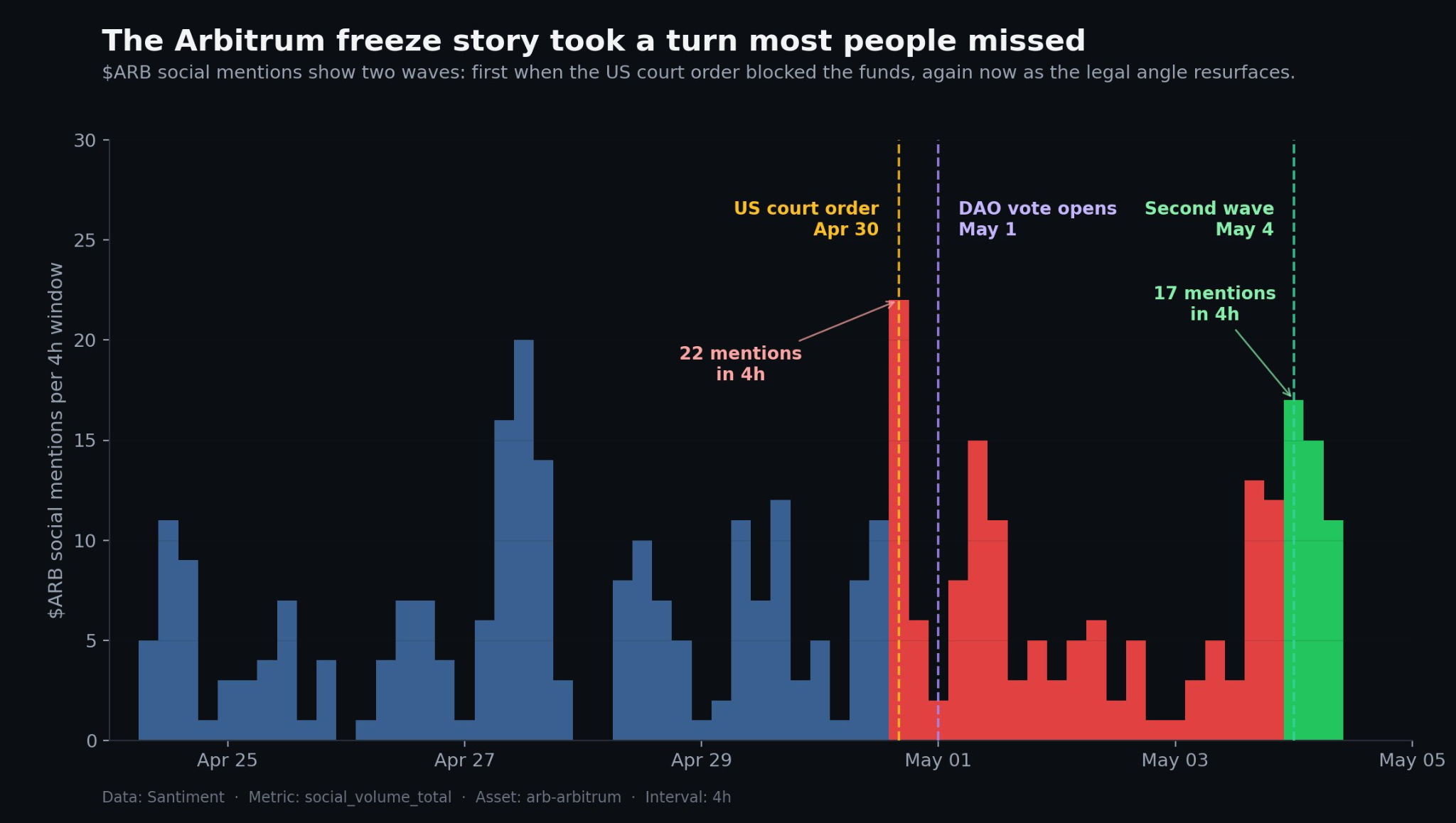
In a post on X, Santiment noted, “The Arbitrum freeze story took a turn missed by many.” It added that ARB mentions moved in two distinct waves tied to key events. The first spike came on April 30 after the restraining order, with 22 mentions in four hours.
Source: X
Activity then cooled before rising again on May 4 to 17 mentions. Hence, the data suggests attention followed legal developments rather than steady market hype.
Legal Action Disrupts DAO Recovery Plans
A U.S. federal court blocked the movement of funds tied to the Kelp DAO exploit, shifting control away from Arbitrum’s governance process. The case involves terrorism victims seeking $877 million in unpaid judgments against North Korea.
Their lawyers argue the stolen Ether qualifies as DPRK-linked property. Charlie Gerstein said the court issued restraining notices and enforcement orders, warning that any transfer could trigger contempt penalties.
Meanwhile, Arbitrum’s DAO had already started a vote to release the funds. The plan was to send the Ether to DeFi United, a recovery fund linked to Aave. Support came quickly, with 16.9 million ARB votes backing the move within hours.
However, the court order stopped the process before it could move forward. As a result, the decision has shifted away from the DAO. The fate of the funds now depends on the outcome of U.S. court proceedings, not the on-chain vote.
Clash Between Law, DeFi, and Victim Claims
The dispute underscores a growing clash between decentralized governance and traditional legal systems. Kelp DAO lost about $292 million in an April 18 exploit linked to North Korea’s Lazarus Group. Arbitrum moved quickly to freeze 30,766 Ether to limit further losses. However, new legal claims now challenge whether those funds should return to exploit victims or go toward unrelated court judgments.
A DAO member warned that “blocking the return of stolen funds to their actual owners shifts the cost.” Critics also argue the legal approach risks redirecting losses to a different group of victims. On-chain investigator ZachXBT described the strategy as “pure evil.”
Related: CFTC Chair Mike Selig Rejects Insider Trading Claims in Prediction Markets
Disclaimer: The information presented in this article is for informational and educational purposes only. The article does not constitute financial advice or advice of any kind. Coin Edition is not responsible for any losses incurred as a result of the utilization of content, products, or services mentioned. Readers are advised to exercise caution before taking any action related to the company.