

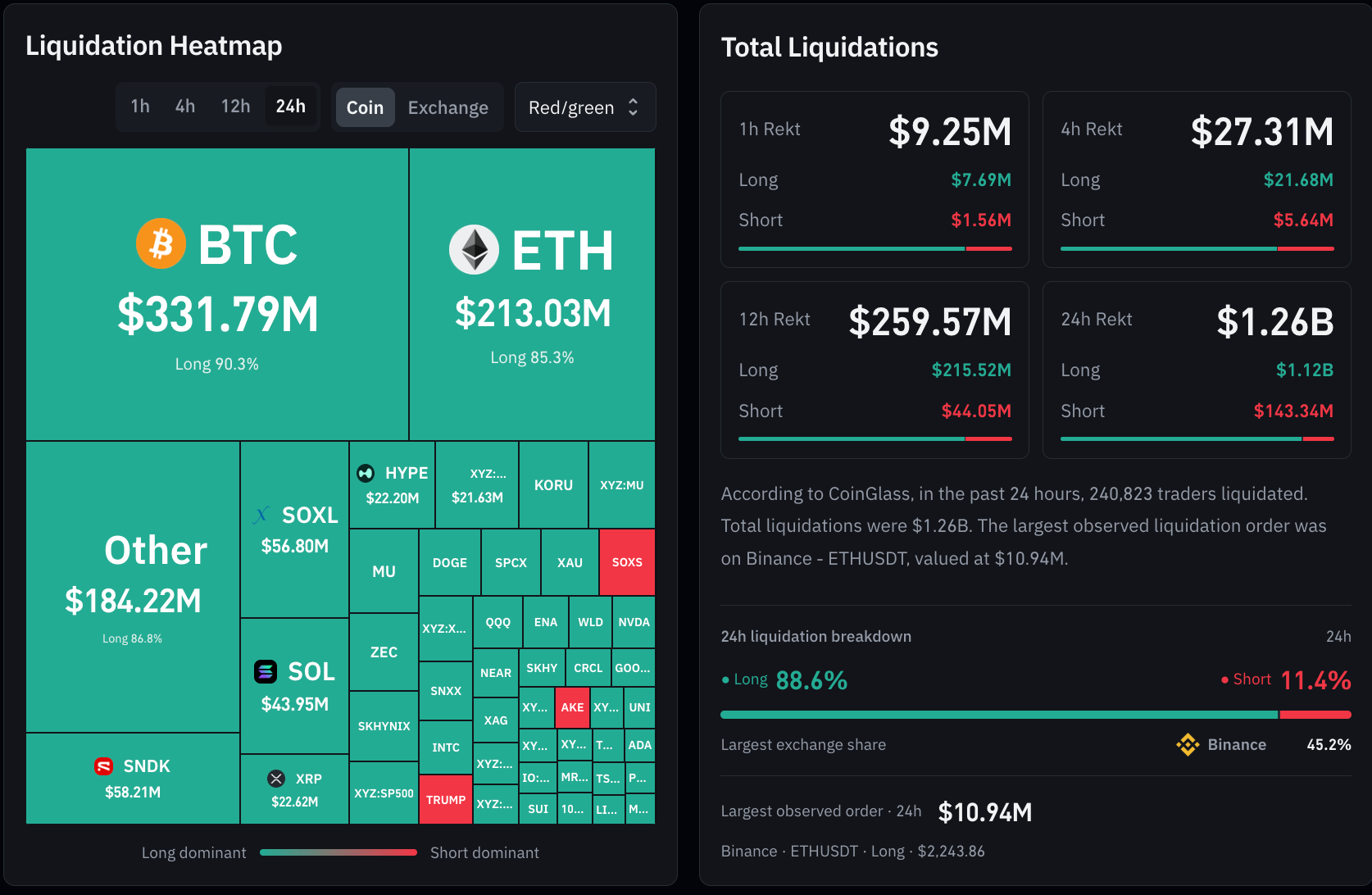
- Crypto liquidations exceeded $1.25B in 24 hours, with long traders accounting for 88.6% of losses.
- Bitcoin and Ethereum recorded $331M and $213M in liquidations, respectively.
- Rising BTC-denominated open interest and weak spot demand suggest another wave of forced selling remains possible.
The crypto market has experienced over $1.2 billion in liquidations in just 24 hours, with Bitcoin and Ethereum taking the biggest hits.
According to CoinGlass, 239,733 traders were affected. Most of the liquidations came from traders who were betting that prices would rise. Bitcoin accounted for $331 million in liquidations, while Ethereum recorded $213 million.
With over a billion dollars wiped out, many are wondering: has the market already experienced the worst, or could more liquidations follow?
Long Traders Suffer the Biggest Losses
Out of the $1.25 billion liquidated:
- $1.11 billion came from long positions (traders betting prices would rise).
- $142.17 million came from short positions (traders betting prices would fall).
This means long traders accounted for 88.6% of all liquidations. Bitcoin saw $297.9 million in long liquidations and $31.7 million in short liquidations. Ethereum also suffered heavily, with $177.5 million in long positions liquidated compared with $31.2 million in shorts.
Binance recorded the largest share of liquidations at 45.2%. Its biggest reported liquidation was an Ethereum trading position worth $10.94 million.
In simple terms, traders who expected crypto prices to rise were forced to close their positions as the market fell.
Falling Open Interest Doesn’t Mean the Selling Is Over
Although the large liquidation event removed some excess leverage from the market, it doesn’t necessarily mean selling pressure is over.
One important thing to understand is open interest. Open interest measures the total number of outstanding futures contracts. When it falls, it can suggest that traders are closing positions.
However, there is a difference between dollar-denominated open interest and coin-denominated open interest. For example, Bitcoin’s dollar-denominated open interest can fall simply because Bitcoin’s price drops. That doesn’t necessarily mean traders are closing their positions.
Coin-denominated open interest gives a clearer picture of whether the actual number of outstanding contracts is decreasing.
A November 2 report from Bitfinex found that Bitcoin futures open interest increased by 12.1% to 694,728 BTC over 19 days, even though Bitcoin’s price fell by 5.3%. This suggests that traders were opening new leveraged positions while prices were declining.
Funding rates also remained positive, showing that traders betting on price increases continued to dominate. This is important because traders can reopen positions after being liquidated. As a result, the market could still experience another wave of forced selling.
Follow us on X for real-time crypto updates.
Spot Market Selling Is Another Problem
The pressure isn’t coming only from futures traders. Investors are also selling their actual Bitcoin holdings.
Bitfinex reported that short-term Bitcoin holders were selling at a loss for the first time since August. Bitcoin’s Spent Output Profit Ratio (SOPR) dropped to 0.992, suggesting that these holders were selling below their purchase prices.
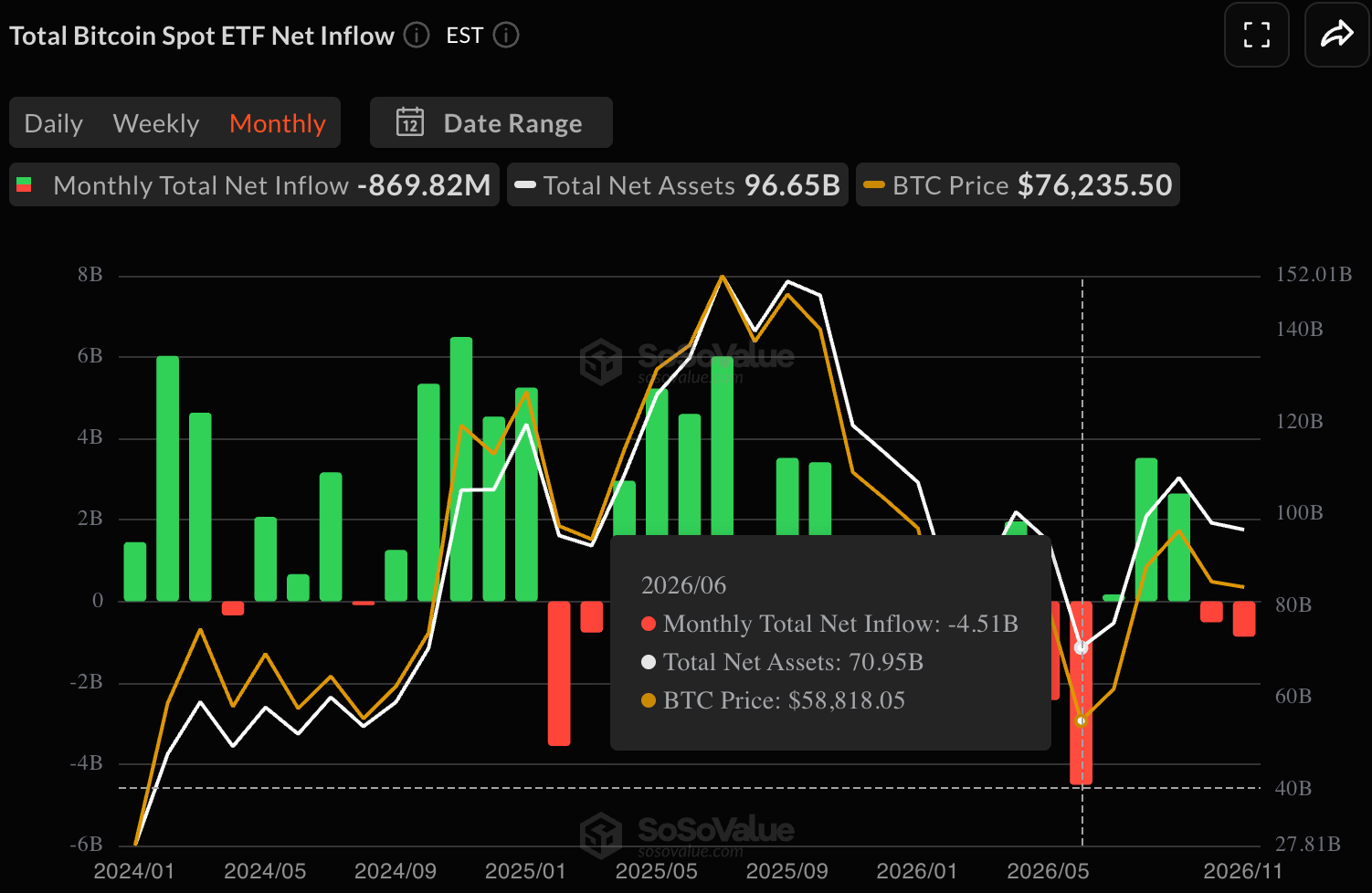
U.S. spot Bitcoin ETFs also recorded $643.2 million in outflows on October 30. This made October their first month of net outflows since June. So far this month, Bitcoin ETFs have sold $870 million in BTC. These figures suggest that demand for Bitcoin was weakening beyond the futures market.
Even if leveraged traders stop selling, continued selling from investors and ETF holders could prevent Bitcoin from recovering.
Bitcoin Liquidation Heatmap Shows More Risk Below $76,000
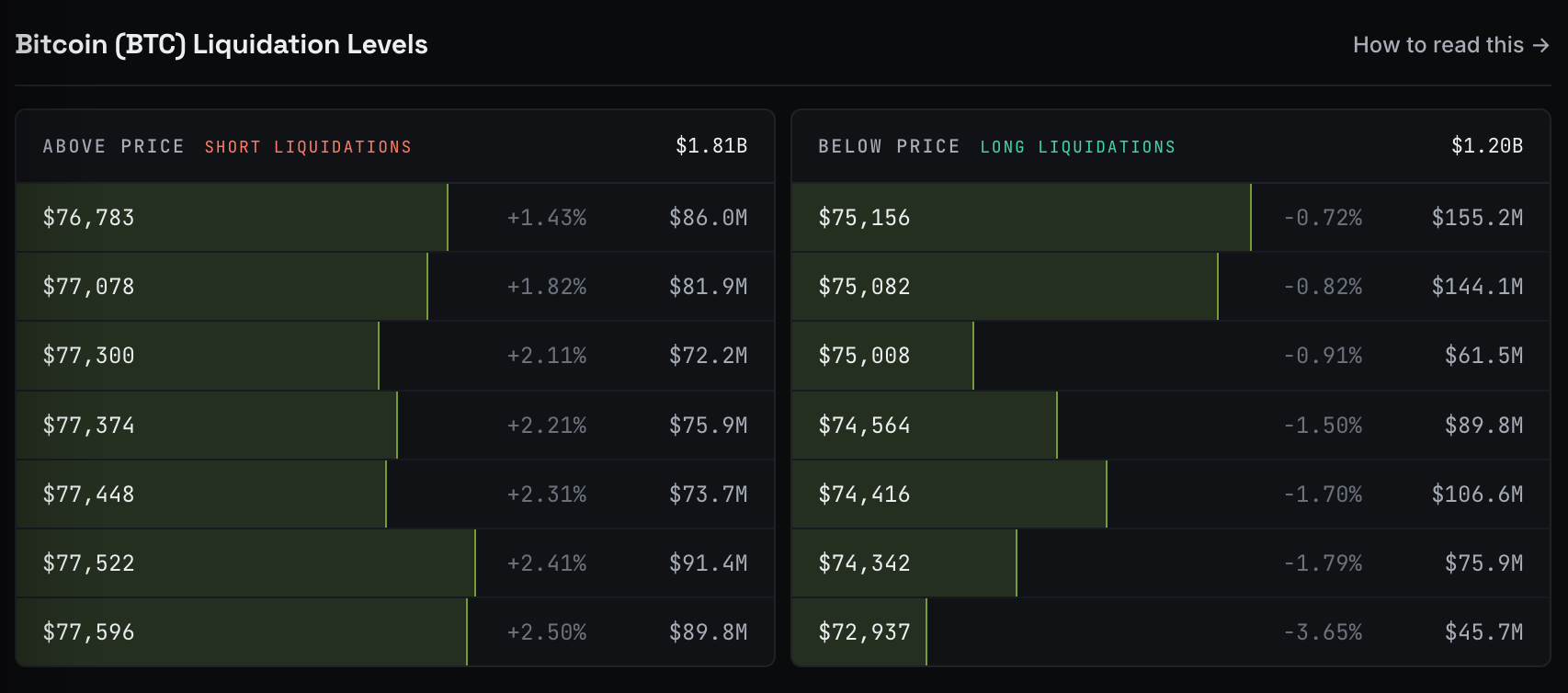
As of November 6, Bitcoin was trading around $75,507. Liquidation heatmap data showed approximately $1.12 billion in estimated long liquidation liquidity below the current price.
Some of the largest liquidation clusters were:
- $147.2 million around $75,206.
- $143.9 million around $75,057.
On the upside, approximately $91.3 million in short liquidation liquidity was identified around $77,517. These figures show that Bitcoin still has significant leveraged positions that could be affected by further price movements. Ethereum is also under pressure following its $210.33 million in liquidations.
Is the Crypto Market Close to the End of Forced Selling?
The $1.25 billion liquidation event is a major setback for bullish crypto traders. However, there isn’t enough evidence to conclude that forced selling is almost over.
Bitcoin futures open interest had increased in BTC terms during the previous price decline. Funding rates remained positive, while spot market demand weakened. This suggests that some leveraged bullish positions may still remain in the market.
For the market to show that selling pressure is finally easing, investors would need to see:
- A sustained decline in coin-denominated open interest.
- Funding rates returning to neutral levels.
- Stronger spot market demand.
- Fewer large-scale long liquidations.
In sum, the recent $1.2 billion liquidation event may have cleared out some overleveraged traders, but it doesn’t guarantee that Bitcoin and Ethereum have reached their price bottoms. Another wave of liquidations remains possible if selling pressure continues.
Subscribe to our YouTube channel for the latest crypto news.
Related: Bitcoin Developer Cory Fields Proposes ‘Quantum Landmines’ to Deter Attacks
Disclaimer: The information presented in this article is for informational and educational purposes only. The article does not constitute financial advice or advice of any kind. Coin Edition is not responsible for any losses incurred as a result of the utilization of content, products, or services mentioned. Readers are advised to exercise caution before taking any action related to the company.