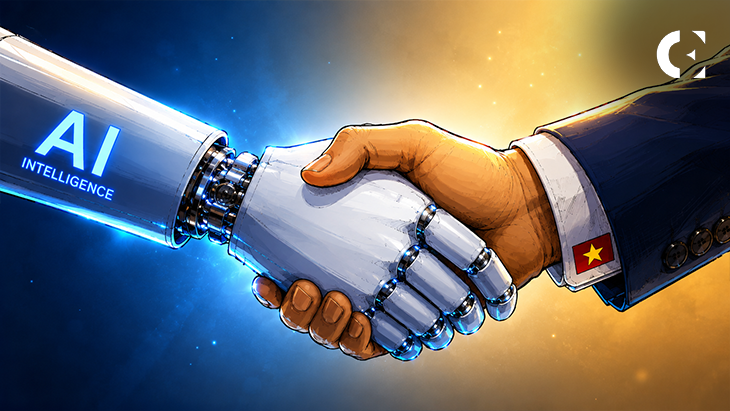

- AI adoption spreads across Vietnam banks as lenders upgrade services and risk controls.
- More than 70% of Vietnam credit institutions have adopted AI and machine learning tools.
- AI governance and power needs rise as Southeast Asia targets a $1 trillion opportunity.
AI adoption is accelerating across Vietnam’s banking sector as lenders use intelligent systems to improve customer service, streamline operations, and strengthen risk controls. The shift comes as Southeast Asia expands digital infrastructure to support long-term economic growth.
Hoang Minh Tien is deputy director general of the Information Technology Department under the State Bank of Vietnam. He said more than 70% of credit institutions have adopted AI and machine learning.
Vietnam Banks Use AI to Improve Digital Services
Banks are using these tools to optimize business processes, improve efficiency, raise service quality, and strengthen customer experience. Tien said the sector has moved beyond isolated pilot projects.
The change marks a new stage for banking technology. Earlier digital banking focused on moving traditional services online. Current adoption is turning AI into an operational infrastructure layer.
Tien said the banking industry is applying the technology across three main areas. Customer-facing services include chatbots, virtual assistants, personalised products, and automated advisory tools.
Operational use cases cover process automation, document handling, data analytics, and cost control. Risk systems now include fraud detection, anti-money laundering, abnormal transaction alerts, credit scoring, and early warning tools.
Vietnamese lenders have already reported high digital transaction levels. Nguyen Hung, CEO of TPBank, said many banks, including TPBank, now process 95% to 99.5% of transactions through digital channels.
Hung said this shows the industry has passed the stage of basic digitalisation. In his view, banks are entering a phase of intelligent digitalisation.
Customer support has become one of the clearest examples of that shift. Traditional call centres and service teams now share work with chatbots, agents, and digital financial assistants.
TPBank has deployed those systems to handle most conventional support tasks, Hung said. As a result, customer requests could be addressed almost instantly.
Techcombank CEO Jens Lottner said deeper changes are taking place inside banking operations. He said the concept of a bank may look different within two to five years. Many tasks may no longer depend fully on human staff, Lottner said. Instead, task-specific AI systems could handle more activity across banking functions.
AI Governance Issues Rise as $1 Trillion Opportunity Grows
Techcombank plans to complete an integrated technology platform in the third quarter of 2026. The platform would allow companies across its ecosystem to share data and operational infrastructure.
However, across Vietnam, lenders are discussing AI-powered call centres, scoring models, fraud prevention systems, sales-support tools, and digital assistants.
Nguyen Ngoc Lan Anh, Chief Technology and Operations Officer of Standard Chartered Vietnam, said the obstacle is not the technology itself. She said execution discipline and governance remain the main barriers.
Lan Anh said meaningful results require clear business goals. Control mechanisms and daily decision-making processes must also support each deployment.
A report by Standard Chartered, Temasek, and the Singapore Green Finance Centre said AI and related infrastructure could add up to $1 trillion to Southeast Asia’s economy by 2030.
The report said nearly half of companies in the region are already scaling intelligent systems beyond pilot projects. It also estimated that Southeast Asia may need up to 15 gigawatts of extra power capacity to support related infrastructure.
Verwandt: Microsoft kennzeichnet zwei bösartige NPM-Pakete, die sich gegen Krypto-Wallets richten
Disclaimer: The information presented in this article is for informational and educational purposes only. The article does not constitute financial advice or advice of any kind. Coin Edition is not responsible for any losses incurred as a result of the utilization of content, products, or services mentioned. Readers are advised to exercise caution before taking any action related to the company.