

- Central bank gold reserves rose to 26.6% of total reserves in 2025, the most since 1993.
- Private investor gold allocation hit 2.7%, the highest portfolio share since 1984.
- Japan’s gold exports hit $25.5B as net exports topped 200 metric tons in FY2025
Gold exposure has climbed to its highest level in 32 years, as central banks and private investors increase allocations to hard assets. The shift reflects growing demand for reserve diversification, inflation protection, and assets less tied to currency risk.
However, the shift is no longer limited to central banks. New allocation data, Japan’s record export figures, and a strong futures chart all point to wider demand for hard assets.
Central Banks and Investors Lift Gold Allocations to Decade Highs
According to The Kobeissi Letter, central bank gold reserves rose to 26.6% of total reserves in 2025. That was the highest share since 1993. The figure has increased by 17 percentage points since 2013.
As a result, the move marks a sharp change from the period when many reserve managers favored U.S. dollar assets and government bonds. Private investors also increased exposure. Kobeissi said private investor gold allocation reached 2.7% of total portfolios last year.
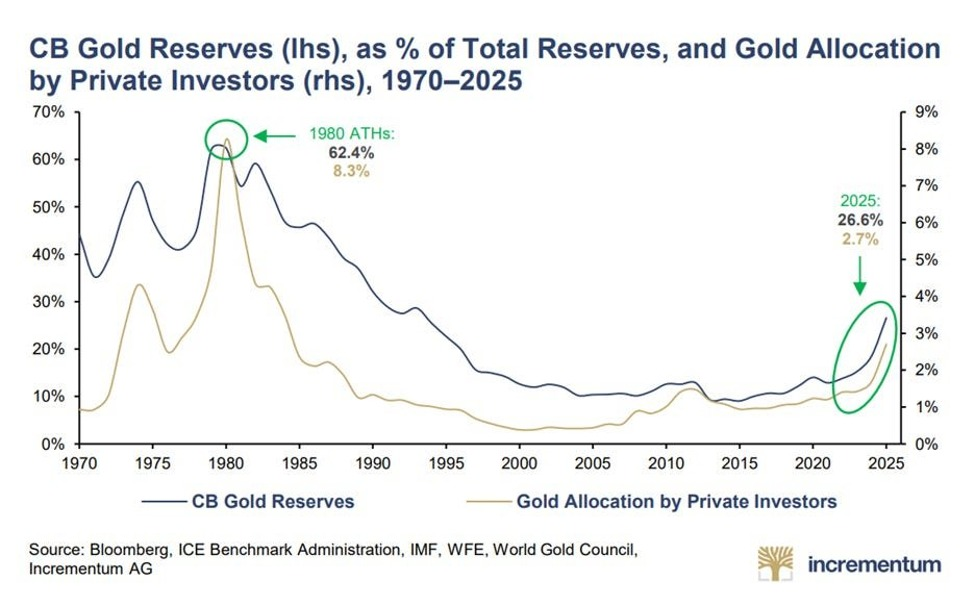
That was the highest level since 1984. The share has more than doubled over five years, showing that demand has expanded beyond official buyers. World Gold Council data also supports the broader reserve shift.
Its database, compiled from IMF International Financial Statistics, tracks reported holdings by country. The council’s 2025 central bank survey found that 95% of respondents expected global official reserves to increase over the next 12 months. Another 43% expected their own central bank to add more.
Japan’s 200-Tonne Gold Export Gap Signals Tight Physical Flows
Japan added another layer to the story through record physical movements. Kobeissi said Japan’s exports surged 35.6% year over year in fiscal 2025, which ended in March 2026. Moreover, exports reached about $25.5 billion, the highest since records began in 1988.
The average export price rose 48.7% year over year to a record $117,400 per kilogram. Kobeissi linked the increase to the surge in global prices. Imports also climbed sharply. Japan’s imports rose 120% year over year to about $1.1 billion, the highest level on record.
Even with that rise, the country exported more than 200 metric tons above imports in fiscal 2025. The net export value reached about $24.4 billion, up 37.9% year over year.
Japan’s domestic production is too small to explain the export growth, according to the Finance Ministry. The ministry said the figures point to outflows of previously smuggled bullion.
Gold Holds One-Year Uptrend Despite Pullback From Record Highs
A separate Scalar Field chart shows that futures have maintained a strong one-year uptrend. GC=F daily closing prices rose from about $3,317 per ounce to around $4,550. That represents a gain of roughly 37% over the past year.
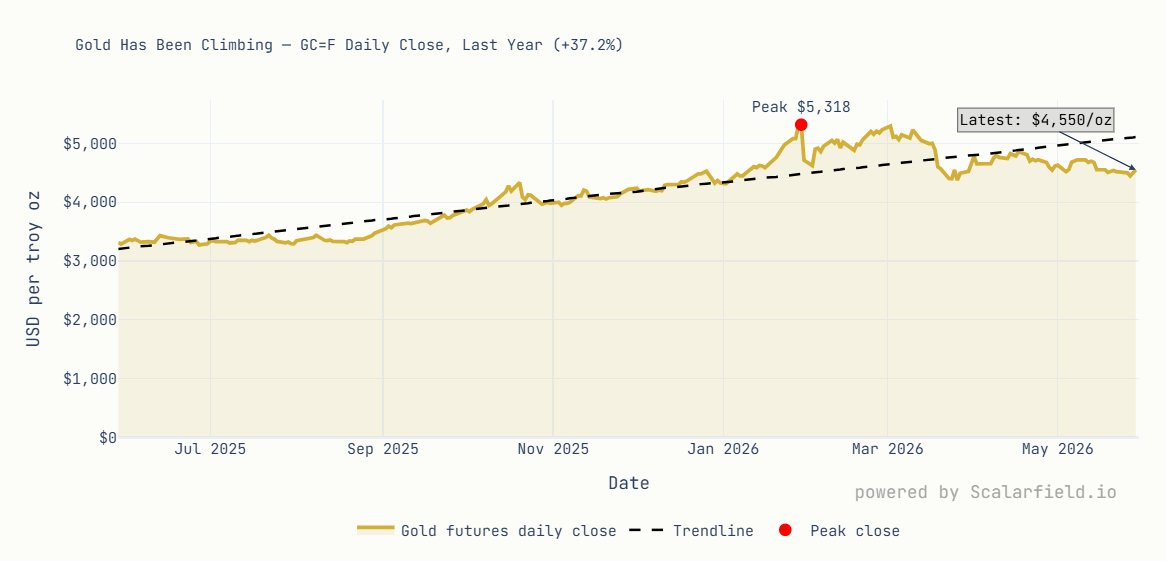
The chart also shows a peak close to $5,318 before the latest pullback. The move has not been smooth, but the broader direction remains upward, with the recent dip below $4,400 described as temporary.
The supplied chart levels placed support above that zone. On the other hand, near-term resistance was identified at $4,600, followed by the previous high near $5,000.
Together, central bank demand, private portfolio shifts, and Japan’s unusual net exports show a broader hard-asset rotation. The data also shows physical supply moving toward markets where demand appears strongest.
Related:CryptoQuant Warns Record BTC Holder Supply May Be Hiding Market Weakness
Disclaimer: The information presented in this article is for informational and educational purposes only. The article does not constitute financial advice or advice of any kind. Coin Edition is not responsible for any losses incurred as a result of the utilization of content, products, or services mentioned. Readers are advised to exercise caution before taking any action related to the company.