

- Germany leads MiCA approvals with 57 licenses, about 23% of all regional authorizations.
- France recorded five late CASP approvals as regulators issued 11 across EU and EEA areas.
- Five EU states had no licenses, while Italy led ESMA’s non-compliant CASP register list.
MiCA licensing is advancing unevenly across the European Union and European Economic Area. Germany holds the largest share of approvals before the July 1 transitional deadline. ESMA interim register data showed 244 authorized crypto-asset service providers across the region.
Germany had 57 approved crypto-asset service providers, or about 23% of all MiCA authorizations. France followed with 26 approvals, equal to roughly 11% of the total.
The Netherlands also ranked among the largest licensing hubs. The data shows that national regulators are moving at different speeds under the same European crypto rulebook.
MiCA Rollout Shows Split Pace Across EU Regulators
The regulation is designed to create a single market for crypto services across the bloc. However, early approval data shows a fragmented rollout before the framework takes effect on Wednesday.
France recorded the strongest recent licensing activity. According to ESMA interim data, the country issued five CASP approvals between June 18 and June 22.
That was the highest number during the period. Across EU and EEA jurisdictions, regulators issued 11 approvals in that window. Malta followed France with two authorizations. France’s approved firms included Bpifrance Investissement, RCUBE Asset Management, Paymium, Leonod and Meria.
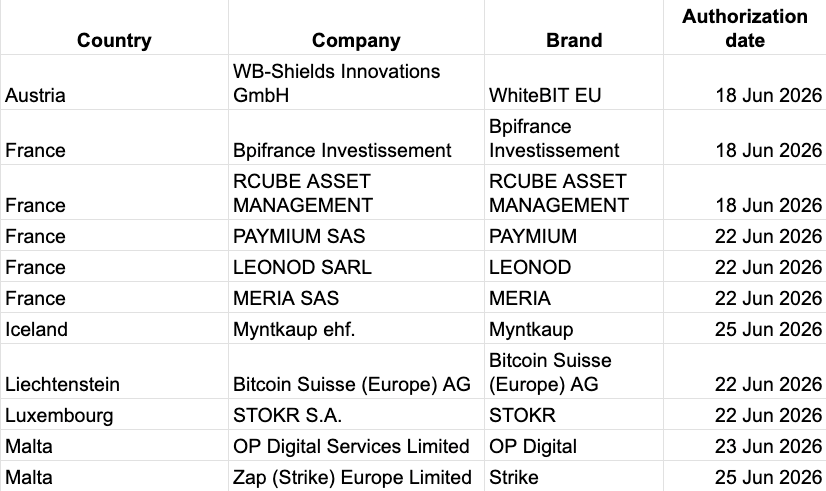
Source: ESMA
Germany’s Federal Financial Supervisory Authority said the country’s high approval count partly reflects the size of its financial sector. BaFin pointed to the large number of credit institutions that can provide crypto-asset services under MiCA.
The regulator also cited Germany’s earlier national licensing regime. That system allowed some crypto firms to use simplified authorization routes under transition rules.
BaFin said it is difficult to predict whether Germany would keep its dominant share of approvals. A spokesperson said future numbers would depend on market developments, innovation trends and pending applications across member states.
The regulator added that approvals in other countries are expected to increase over time. It said licensing levels may broadly align with the size of each national financial sector.
MiCA Gaps Leave Five EU States Without Licenses
Five EU member states had not issued any MiCA licenses as of June 26. ESMA data listed Greece, Hungary, Poland, Portugal and Romania among those without approvals.
Greece stood out because Binance had applied for authorization there. The exchange later withdrew the application and moved its licensing plans to another jurisdiction under the framework. Poland also remained without an active licensing framework. The delay followed slow progress on implementation legislation and three reported presidential vetoes.
However, ESMA’s non-compliant CASP register also showed a sharp concentration in Italy. As of Friday, Italy accounted for 160 of 162 entries on the list. The Netherlands and Slovakia each recorded one entry. Those were linked to MEXC and LWEX, respectively.
MiCA aims to bring crypto companies under one regulatory structure across Europe. The early data shows that implementation still depends heavily on national regulators, existing laws and the pace of domestic approvals.
Related: Binance Warns Some EU Clients May Lose Services After Greek MiCA Bid Fails
Disclaimer: The information presented in this article is for informational and educational purposes only. The article does not constitute financial advice or advice of any kind. Coin Edition is not responsible for any losses incurred as a result of the utilization of content, products, or services mentioned. Readers are advised to exercise caution before taking any action related to the company.