

- USD/JPY has dropped below the 156.50 mark as the Japanese yen strengthens, but Bitcoin keeps rising.
- Weak Japan factory output has dampened expectations for another Bank of Japan rate hike.
- The key question now is whether BTC is anticipating liquidity rather than reacting to current FX stress.
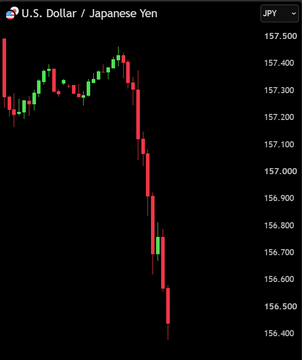
On September 30, 2026, the USD/JPY currency pair fell below the 156.50 mark as the Japanese yen (JPY) surged on weak factory data. Bitcoin (BTC), however, is holding firm in the $83,000-$84,000 range, avoiding the sharp selloffs often associated with yen strength, raising questions about whether it is anticipating easier liquidity.
Why Is USD/JPY Falling as the Yen Strengthens Despite Elevated Yields?
USD/JPY fell below 156.50, down 0.2 – 0.5% on the day, with intraday lows nearing 156.4, adding to a recent downtrend despite high U.S. Treasury yields. Finance Minister Satsuki Katayama stated that the weak yen is a problem and that Japan is coordinating closely with the United States on foreign-exchange markets.
Top currency diplomat Atsushi Mimura reinforced the message, saying markets should take the “very clear” signal from Japan’s prime minister, finance minister, and U.S. counterparts at face value.
Although the medium-term outlook of USD/JPY remains bullish from a structural standpoint due to higher U.S. yields, the short-term market picture is being driven by intervention concerns, end-of-period flows, positioning for upcoming U.S. data, and residual hawkish Bank of Japan (BOJ) signals. So far, these factors have temporarily outweighed the rate differential, allowing the yen to strengthen and USD/JPY to decline.
Why Is Bitcoin Holding Up Despite FX and Carry-Trade Risks?
Despite the ongoing pullback in USD/JPY and a return of classic carry-trade unwind fears, Bitcoin is displaying significant resilience. Recent historical correlation data already challenged the simple carry-trade narrative, with Bitcoin’s 52-week rolling correlation with USD/JPY reaching approximately –0.90 in mid-2026, an unusually strong inverse relationship.
At the same time, Bitcoin is displaying clear relative strength versus the FX move. While USD/JPY has dropped into the mid-156s amid intervention warnings and month-end flows, BTC has held the bulk of its September gains and is not breaking down.
This implies that crypto-specific issues such as the presence of ongoing institutional demand, technical momentum from the mid-month bounce, and possible positioning that takes into account the earlier volatility in the yen are dominating the pure macro FX stress.
This suggests a temporary divergence rather than a full decoupling, as correlations in crypto remain highly regime-dependent. A sharper yen rally could accelerate deleveraging and increase pressure on risk assets, including Bitcoin.
Could Yen Strength Trigger a Carry Trade Unwind and Pressure Bitcoin?
Continued yen strength could eventually force a carry-trade unwind and challenge Bitcoin’s bullish momentum. A sharper yen rally could increase margin pressure on leveraged investors, forcing them to sell risk assets, including Bitcoin.
The risk would increase if there is actual intervention, a more forceful BOJ tightening cycle, or a self-reinforcing short yen sell-off that sends USD/JPY much further, leading to a further round of deleveraging and renewed pressure on BTC.
BTC Holds Key Levels as Macro Diverges
Bitcoin’s price level resilience suggests that, at this stage, BTC is more responding to its technical structure, the remaining institutional demand, and the internal market dynamics than the ongoing FX and carry-trade stress. At press time, BTC was trading at $83,880.13, down 0.5% in the past 24 hours.
Immediate support lies at $82,500-$83,000, with a deeper cushion at $82,500-$82,000. A daily close below$82,500-$82,600 would weaken the short-term bullish structure. On the upside, resistance stands at $84,000-$85,200, while a sustained move above $87,250-$87,400 would strengthen the case for continued upside.
The current divergence between USD/JPY and Bitcoin highlights a shifting dynamic in how crypto responds to macro signals. While yen strength and carry-trade risks typically pressure risk assets, Bitcoin’s resilience suggests that internal demand and positioning are currently playing a larger role.
However, this divergence may not hold if macro conditions tighten further. A stronger yen or a broader deleveraging cycle could still transmit pressure into crypto markets. For now, Bitcoin remains supported, but traders are watching closely to see whether it can maintain this strength if global liquidity conditions turn more restrictive.
Related: Why a Stronger Japanese Yen Could Signal Changing Conditions for Bitcoin
Disclaimer: The information presented in this article is for informational and educational purposes only. The article does not constitute financial advice or advice of any kind. Coin Edition is not responsible for any losses incurred as a result of the utilization of content, products, or services mentioned. Readers are advised to exercise caution before taking any action related to the company.