
- 56% of tokenized RWA value, or $32.9B, showed zero weekly on-chain transfer now.
- Just 62 assets hold 88% of the total $60B tokenized RWA market value right here.
- Only tokenized US Treasuries reached production-grade maturity among 12 classes.
The tokenized real-world asset market has reached approximately $60 billion, but a new report reveals a gap between the headline number and actual market activity.
Of 1,289 tokenized assets each valued above $100,000, only 379 showed any weekly transfer activity. The remaining 910 had no on-chain transfers at all. In value terms, $32.9 billion, or roughly 56% of the total market, recorded zero weekly movement. The 379 active assets generated $26.2 billion in transaction volume.
The report makes clear this does not automatically signal failure. Some tokenized products are not designed for secondary market trading and function more as digital certificates than instruments meant to change hands frequently. But the data does point to a market where issuance has outpaced actual utility.
Concentration Is Extreme
More than 7,000 tokenized assets exist, but the market’s value is remarkably narrow. Just 62 assets account for 88% of total value. Five products alone represent roughly half the entire market.
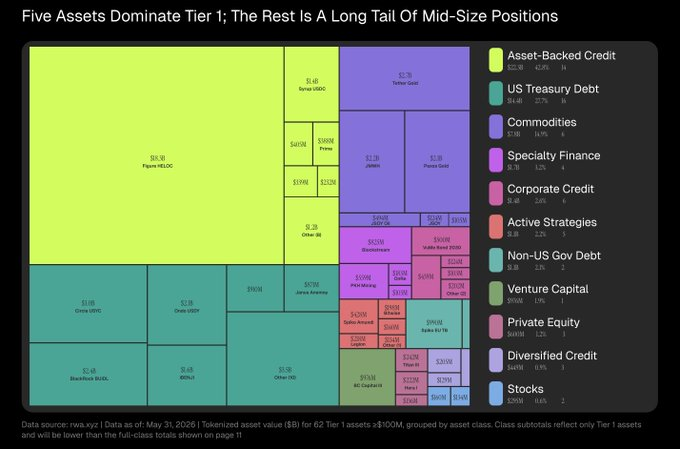
The image shared alongside the report’s findings shows asset-backed credit and US Treasury debt dominating the top tier, with everything else forming a long tail of mid-size positions.
Only One Asset Class Has Reached Maturity
Of the 12 asset classes tracked, only tokenized US Treasuries have reached what the report calls production-grade maturity. Every other category remains at earlier stages of development, either still proving the concept or building the infrastructure needed for meaningful scale.
Related: 24 Hour Crypto Recap: Here’s What Happened in the Market
Who Can Actually Access It
The access problem is striking. Ninety-seven percent of the tokenized RWA market remains outside the reach of US retail investors. Thirty-nine percent of the market lacks a clear regulatory framework. These two figures together explain much of why activity levels remain low despite the impressive overall valuation.
The Infrastructure Gap
The report frames the main challenge as a difference between tokenization and adoption. Putting an asset on a blockchain is the easy part. Making it liquid, tradable, and composable within broader financial systems requires decentralised exchanges, cross-chain interoperability, standardised protocols, and regulatory clarity that most markets have not yet established.
The success of tokenized Treasuries, the one category that has crossed into genuine adoption, demonstrates what is possible when regulation, institutional trust, infrastructure, and investor demand align simultaneously. The rest of the market is still waiting for those conditions to converge.
Related: Robinhood Launches Robinhood Chain With Tokenized Stock Trading
Disclaimer: The information presented in this article is for informational and educational purposes only. The article does not constitute financial advice or advice of any kind. Coin Edition is not responsible for any losses incurred as a result of the utilization of content, products, or services mentioned. Readers are advised to exercise caution before taking any action related to the company.