



- Binance retail BTC inflows fell to 281 BTC from a previous peak near 2,700 BTC.
- U.S. spot Bitcoin ETFs offer brokerage exposure without direct BTC exchange deposits.
- Binance’s October 29 security breach came years after the decline in small deposits began.
Retail Bitcoin transfers into Binance are shrinking, although BTC trades far above its previous bear-market low. The divergence raises questions about changing investor access and custody habits, which price analysis cannot resolve.
Retail Inflows Diverge From Earlier Market Cycles
CryptoQuant analyst Darkfost reported November 3 that the 30-day average for deposits smaller than one Bitcoin at Binance reached 281 BTC. During 2019–2021, comparable flows peaked around 2,700 BTC, nearly ten times today’s level.
Following FTX’s collapse, early 2023 inflows recovered to approximately 1,900 before declining again. Even Bitcoin’s March and December 2024 highs prompted only 900–1,200 BTC spikes.
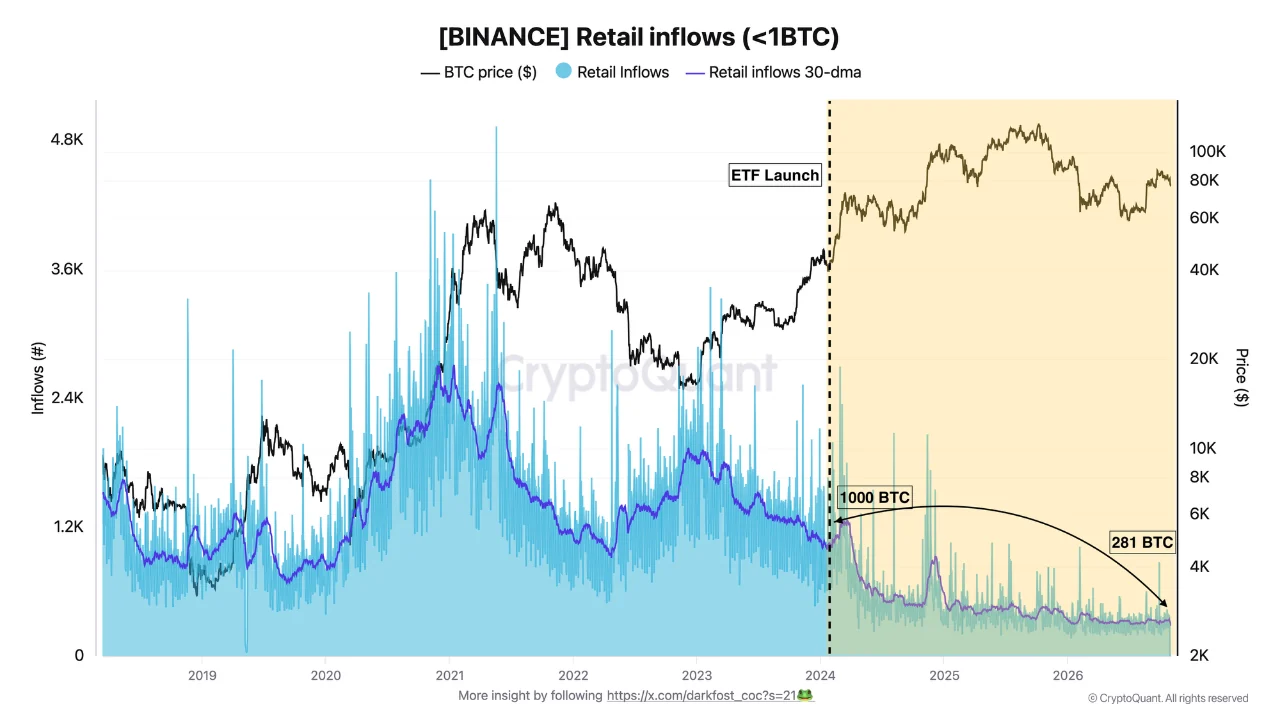
Darkfost contrasted that decline with Bitcoin trading at roughly five times its bear-market low. Small deposits, meanwhile, are about five times lower. The comparison challenges the assumption that rising valuations necessarily prompt greater exchange activity. However, price analysis cannot distinguish sales preparation from routine transfers.
Follow us on X for real-time crypto updates.
Spot Bitcoin ETFs Offer Exposure Without Direct Exchange Deposits
Meanwhile, the January 2024 launch of U.S. spot Bitcoin ETFs offers a potential structural explanation. At that point, Binance inflows averaged roughly 1,000 BTC. Since then, ETFs have let investors obtain exposure through brokerage accounts instead of sending Bitcoin to trading platforms.
Darkfost also cited tighter trading rules in the United States and Europe and greater willingness to hold coins long-term. These shifts remain possible explanations, but price analysis cannot verify causation.
Moreover, price analysis must account for a measurement limit: the dataset records transfers below one coin, not verified retail identities. Small deposits can come from different investor types. Consequently, price analysis cannot measure retail participation, ETF migration, or overall holdings from this series alone.
Binance Withdrawal Reopening Follows Years of Falling Retail Inflows
Separately, Binance said on November 3 that further withdrawals would restart progressively from 04:00 UTC, following the November 1 reopening. Asset availability remains subject to security checks, and deposits stay open.
Binance said it would absorb losses from the October 29 breach. The multiyear decline at Binance preceded the incident, so the attack cannot explain the broader trend. Bitcoin price analysis needs that distinction: fewer coins reaching exchanges do not automatically indicate buying pressure.
Darkfost said today’s volumes are too small to drive markets materially. Ultimately, BTC price analysis identifies a shift in deposit behavior, not conclusive evidence about investors’ motives.
Subscribe to our YouTube channel for the latest crypto news.
Related: Bitcoin Price Analysis: Bullish BTC Shift Eyes $81,971 Ahead of U.S. Midterms
Disclaimer: The information presented in this article is for informational and educational purposes only. The article does not constitute financial advice or advice of any kind. Coin Edition is not responsible for any losses incurred as a result of the utilization of content, products, or services mentioned. Readers are advised to exercise caution before taking any action related to the company.