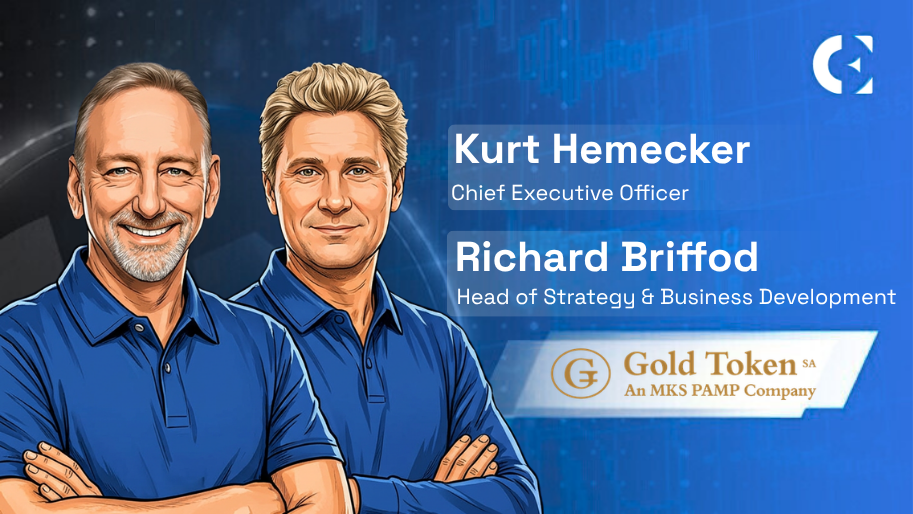

1. The Crypto Valley Conference is widely regarded as an indicator of the future direction of the blockchain and crypto industries. So what did you get out of this year’s conversations, and what trends do you think are most important to watch out for over the coming years in relation to the market?
Richard Briffod: It may sound a bit cliché, but two major trends clearly dominated discussions at this year’s Crypto Valley Conference.
The first is the institutionalization of blockchain-based assets, particularly tokenized financial assets. We have been talking about this for years, but it now feels as though the market is finally reaching an inflection point. The growth of tokenized real-world assets (RWAs) is set to accelerate across the financial industry. This creates both excitement and some degree of concern. One of the key questions for the Swiss financial ecosystem is whether Switzerland will be able to maintain the leadership position it established during the rise of cryptocurrencies. There is a certain level of anxiety around this, especially given the pace of regulatory developments in other jurisdictions compared with Switzerland.
The second major trend is, of course, AI, which was discussed from at least two different perspectives.
First, there is a strong belief within the crypto community that blockchain has an important role to play in an AI-driven world, where machines and algorithms will increasingly perform tasks that are currently managed by humans. Blockchain technology was, in many ways, designed for machine-to-machine transactions and can also provide mechanisms to address some of the risks associated with AI, including data integrity, traceability, and accountability. Interestingly, while the crypto industry appears convinced that blockchain will be a critical component of the AI ecosystem, the AI community itself does not yet seem particularly focused on what blockchain can contribute.
Second, AI is creating a new level of cybersecurity risk. We have already seen a rise in sophisticated exploits and attacks over recent months, and this challenge is particularly acute for the crypto industry because it is fundamentally built around the transfer and storage of value. Many side discussions focused on how AI should increasingly be used as a defensive tool to detect threats, strengthen security systems, and protect against these emerging AI-enabled risks.
2. One of the topics discussed at the conference was tokenization and real-world assets, which was touched upon several times throughout the event. According to Gold Token S.A, why do tokenized gold assets stand apart in the larger world of RWAs?
Richard Briffod: That is a very good question, and I would actually start by saying that tokenized gold is already standing apart within the broader RWA ecosystem.
There are several reasons for this.
First, tokenized gold is one of the earliest successful examples of real-world asset tokenization, with some of the first initiatives dating back to 2019.
Second, tokenized gold has become one of the largest RWA categories in the market. Today, it represents approximately $5 billion in market capitalization, making it the second-largest tokenized asset class after tokenized U.S. Treasuries. This is particularly remarkable considering that gold represents only a small share of the broader traditional financial market. In other words, gold appears to be disproportionately successful in its tokenized form.
Third, transaction activity is exceptionally strong. During the first quarter alone, tokenized gold generated close to $90 billion in transaction volume—roughly 18 times its market capitalization. This highlights that tokenized gold is not only being held as an investment asset but is also being actively used and transferred within the digital asset ecosystem.
Beyond these figures, the key differentiator is that tokenization delivers tangible benefits to gold investors. It combines the stability and store-of-value characteristics of physical gold with the accessibility, transferability, divisibility, and 24/7 liquidity of digital assets. Investors can gain exposure to gold without many of the constraints associated with physical ownership, while also benefiting from features that traditional gold ETFs cannot easily provide, such as seamless on-chain settlement and integration with decentralized financial infrastructure.
This is why tokenized gold stands out within the RWA market. In many other asset classes, tokenization mainly improves operational efficiency. In the case of gold, tokenization fundamentally enhances the investor experience, creating a much stronger value proposition and helping explain its rapid adoption.
3. During the ‘Capital Markets 2030: Tokenization, RWAs, and the Future of On-Chain Treasury’ panel discussion, Kurt, you were one of the speakers. How do you see tokenized assets changing treasury management in the coming years?
Kurt Hemecker: Tokenized assets will make treasury management faster, more transparent and more flexible, without changing the fundamentals many treasurers care about which are safety, liquidity and control.
By bringing assets like Treasuries, money-market funds and gold on-chain, institutions can move and verify collateral more efficiently, settle faster and manage liquidity around the clock. For gold specifically, tokenization turns a historically static reserve asset into something more portable and usable, while preserving its role as a trusted store of value.
4. Your workshop discussed ‘Sound Money on Digital Rails’, emphasizing the importance of gold as a tokenized real-world asset. Why do you think that gold is still relevant in today’s fast-changing digital environment, and how can blockchain technology make it more valuable?
Richard Briffod: I would start by saying that gold has rarely been more relevant. We are currently in a secular growth phase, with gold reaching record levels in both absolute and inflation-adjusted terms. Nicky Shiels, one of the most prominent precious metals analysts, summarizes the drivers as the 3 Ds: debasement, de-dollarization, and diversification.
“Debasement” reflects the structural erosion of fiat currencies, driven by debt; US debt has reached approximately $36 trillion, with no credible path to reducing it. “De-dollarization” is geopolitical: central banks have become the single largest category of gold buyers, building reserves they can hold without depending on anyone else’s good faith. “Diversification”, finally, reflects the fact that gold still represents only around 2 to 3% of investment portfolios, a legacy of the decades when it was dismissed as a yieldless asset. As allocators rediscover its decorrelation from equities, the conversation has moved from 3% allocations toward 5, 10, even 15%.
So the demand for gold is clearly there. The question, therefore, is the instrument. Physical gold comes with storage, logistics, and resale friction. ETFs made gold tradable, but they charge around 40 basis points per year for a claim on a fund rather than on the metal itself.
At the same time, we are witnessing a much broader movement: virtually all assets are moving on-chain, and gold is already among the largest tokenized categories. Tokenization brings to gold precisely what it was missing. It trades 24/7, settles in seconds, is divisible from 1 gram, and can be used as collateral, something a bar in a vault could never do. With DGLD, the holder owns a property right on an identified bar under Swiss law, can take delivery in physical gold almost anywhere in the world within 48 hours.
Gold has always been sound money. Blockchain finally gives it the digital rails.
5. The institutional demand for tokenized assets is increasing, yet issues of trust, liquidity, and interoperability remain unresolved. Which obstacles still affect the mainstream adoption of tokenized gold and other real-world assets?
Richard Briffod: I am confirming that from our discussions, that there is an increased interest of institutions in tokenized gold, but today there is hardly any adoption of tokenized gold by institutional actors.
What makes this particularly interesting is that the situation is very different for other categories of real-world assets, such as tokenized U.S. Treasuries, where adoption has largely been driven by institutional investors.
The question, therefore, is why this gap exists.
It seems that the answer lies in the fact that the issuer profiles of current major tokenized gold offerings are not able to pass the risk and compliance assessment of institutional actors.
In the case of tokenized gold, two questions are especially important:
- Where is the physical gold stored?
- Under which jurisdiction and legal framework is the token issued?
These factors are critical because an investor’s ability to ultimately access and get back the underlying gold depends on them. Issues of jurisdiction, sovereignty, legal enforceability, and counterparty risk all come into play.
As CZ, the founder of Binance, famously commented last year, tokenized gold is often perceived as a “trust me bro” asset. While the expression is provocative, it highlights an important reality: unlike native digital assets, tokenized gold inevitably relies on trusted third parties. The quality and credibility of those third parties therefore become fundamental.
This is where we believe the industry still has work to do. Many existing tokenized gold structures have been successful in attracting retail investors, but they have not met the governance, compliance, and risk-management standards required by large institutional investors.
This is precisely the gap that DGLD aims to address. By combining institutional-grade governance, strong custody arrangements, and a trusted Swiss framework, our objective is to become the partner of choice for financial institutions seeking exposure to tokenized gold.
6. The Crypto Valley is well-known worldwide as a center of excellence for blockchain technologies. How important are conferences like the Crypto Valley Conference for crypto adoption? And how would you like to participate in that process through Gold Token SA?
Kurt Hemecker: Your question actually makes me smile because I recently had a conversation with a former executive from a traditional financial institution who recently joined the crypto industry. He was both impressed and somewhat puzzled by the sheer number of conferences taking place around the world and by the fact that so much of the industry seems to spend its time traveling between them.
Yet, from my experience, these conferences play a critical role in the development of the ecosystem, especially events such as the Crypto Valley Conference.
The reason is simple: blockchain and digital assets are still relatively young industries, where trust, partnerships, and knowledge sharing remain essential. Many of the most important collaborations, investments, and strategic initiatives begin through direct conversations between market participants.
What makes the Crypto Valley Conference particularly important is its historical role as a meeting point between traditional finance and the crypto industry. Long before tokenization became a mainstream topic, the conference provided a platform where banks, regulators, technology providers, entrepreneurs, and investors could engage with one another. That bridging role remains just as relevant today as the worlds of traditional finance and digital assets continue to converge.
Switzerland also benefits from a unique position in this respect. As global competition intensifies and geopolitical considerations become increasingly important, trust, legal certainty, and jurisdictional stability are becoming strategic advantages. Crypto Valley has built a reputation around these values, and that reputation continues to attract international participants.
For Gold Token SA, participating in this ecosystem goes beyond simply attending conferences. Our objective is to contribute to the dialogue around tokenization and help demonstrate how blockchain technology can create tangible value through real-world use cases. We believe tokenized gold is one of the clearest examples of how traditional assets can be successfully brought on-chain while meeting the standards expected by institutional investors.
We greatly enjoyed our participation at this year’s Crypto Valley Conference and look forward to contributing to future Crypto Valley initiatives, including the Banking Symposium, as the conversation around tokenized assets and digital finance continues to evolve.
Disclaimer: The information presented in this article is for informational and educational purposes only. The article does not constitute financial advice or advice of any kind. Coin Edition is not responsible for any losses incurred as a result of the utilization of content, products, or services mentioned. Readers are advised to exercise caution before taking any action related to the company.