

- Hyperliquid runs on fewer than 15 employees, with no marketing or sales team whatsoever.
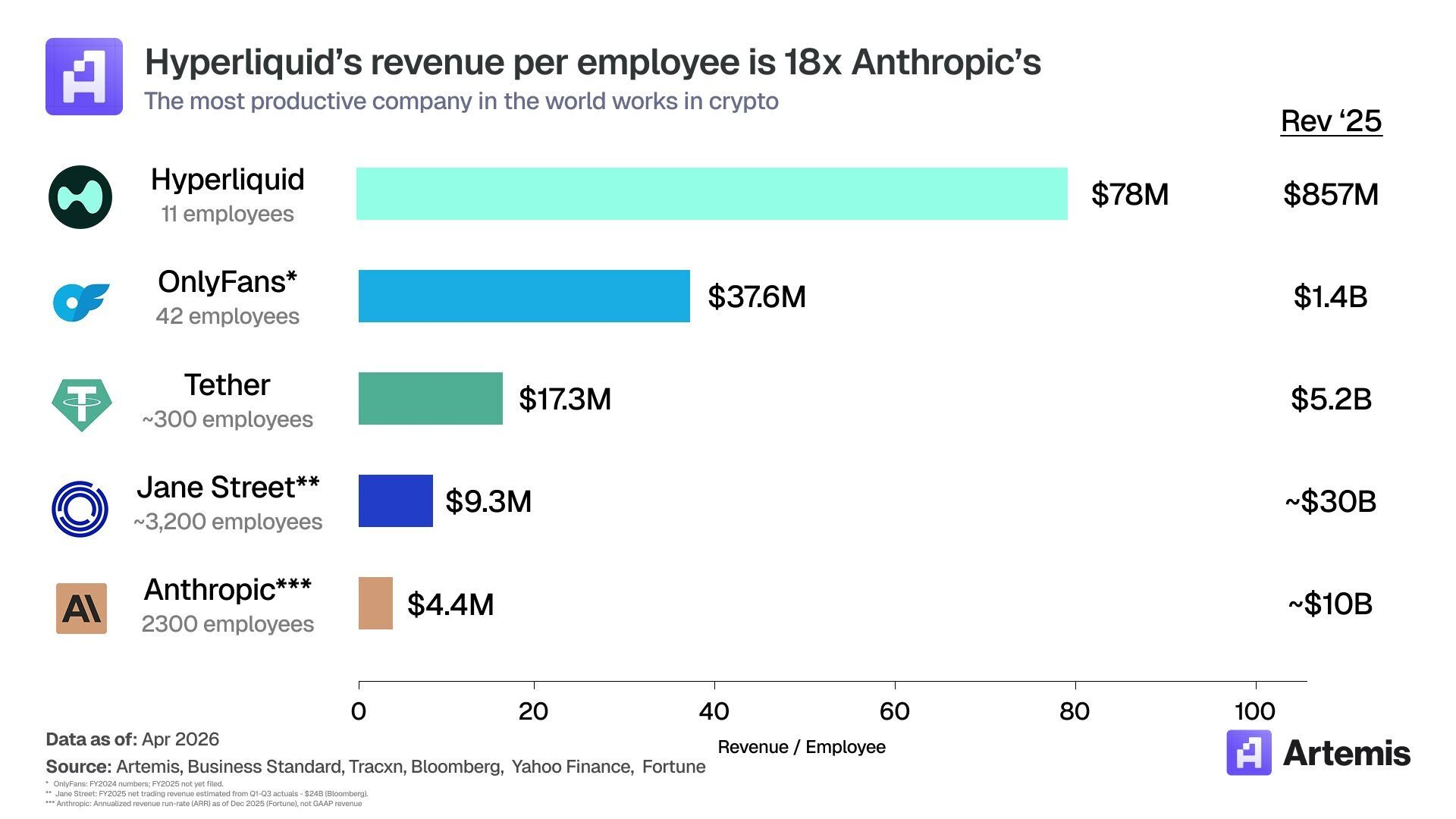
- Protocol generated $78 million in revenue per employee in 2025, according to Artemis.
- Yan says that anything the community can build, Labs should not touch, and the market decides.
In an industry obsessed with headcount, funding rounds, and corporate expansion, Jeff Yan is doing the opposite. And he thinks that’s exactly why Hyperliquid is winning.
Yan, the founder of Hyperliquid, recently pulled back the curtain on one of the most talked-about aspects of the protocol: its famously small team. No marketing department and no sales team. Just engineers, and a community that, according to Yan, does the outreach job better than any hired team ever could.
For the unversed, Hyperliquid operates with a team of less than 15 employees. Artemis also reported that the company generated $78 million in revenue per employee in 2025.
“It’s In Our DNA”
For Yan, staying lean isn’t a cost-cutting strategy. It’s a philosophy. “We genuinely believe in individuals having outsized impact,” he explained, adding that cutting corporate bureaucracy isn’t just a business decision — it’s baked into what Hyperliquid is building at its core.
His argument is that crypto, by its very nature, is a space where individual contributors and decentralized communities can outperform bloated organizations. So why build one?
Let the Market Decide
Yan also opened up about his stance on what Labs should and shouldn’t build. His answer? If the community can build it, Labs shouldn’t touch it.
“Anything that Labs doesn’t need to do, I don’t think it should,” he said bluntly. “If something can be built by the community or by someone in the community, it should.”
He believes market-driven outcomes, shaped by real user preference and open competition, almost always produce better products than anything handed down from the top. “The product that comes out of competition is almost always better than a product coming from above somewhere,” he said.
Open Infrastructure, Open Ecosystem
The strategy hinges on keeping Hyperliquid’s core financial primitives fully open. By doing so, the protocol essentially becomes a foundation that outside developers, aligned teams, and independent builders can build on, without waiting for Labs to greenlight anything.
It’s a model that flips the traditional startup playbook on its head. Instead of building everything in-house and scaling the team to match, Hyperliquid scales through its ecosystem while the core team stays sharp, focused, and fast.
A Bet That’s Playing Out Loudly
Spot trading is one example Yan pointed to, something the community ran with in ways Labs never would have prioritized internally.
Whether this approach holds as Hyperliquid grows will be one of the more fascinating stories to watch in crypto. But for now, Yan isn’t second-guessing the model.
In a space full of companies trying to look like protocols, Hyperliquid is a protocol that refuses to become a company.
Related: Binance and Hyperliquid Lead Crypto Market Trends in Q1 2026 Report
Disclaimer: The information presented in this article is for informational and educational purposes only. The article does not constitute financial advice or advice of any kind. Coin Edition is not responsible for any losses incurred as a result of the utilization of content, products, or services mentioned. Readers are advised to exercise caution before taking any action related to the company.