
- A $37,000 market order briefly pushed XRP to $50 on Gemini amid thin liquidity.
- Banks cannot use XRP on demand and must hold pre-funded dedicated liquidity pools themselves.
- A $200B transfer at $20 per XRP would consume 16% of the entire circulating supply at once.
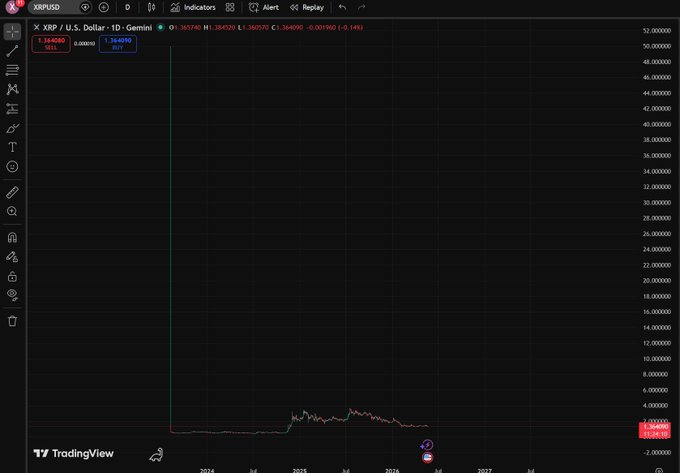
In August 2023, XRP briefly printed $50 on Gemini. The crypto community laughed it off as a data error. Computer engineer and XRP analyst CharuSan says the people laughing missed the most important liquidity lesson in XRP’s history.
“It wasn’t a glitch. It was a 100% real market event and a perfect example of catastrophic slippage.”
The mechanics were simple. XRP had just been relisted on Gemini, and the order book was almost empty. A single market buy order swept through every available sell order in seconds and kept going until it hit one rogue sell order sitting at $50. The total volume required to move the price from its normal trading range to $50 was just $37,000.
Scale That to a Bank Transfer, and the System Collapses
CharuSan’s argument is not about that one candle. It is about what that candle reveals when you scale it to institutional volumes.
If $37,000 on a thin order book causes catastrophic slippage to $50, what happens when a major bank initiates a multi-billion dollar cross-border transfer using XRP on-demand?
The order book cannot absorb the volume, and the price spikes instantly and uncontrollably. The transfer either fails completely or settles at a price so far from the intended rate that it becomes operationally useless.
His conclusion was that banks cannot use XRP as passive plug-and-play users of On-Demand Liquidity. They must hold pre-funded, locked XRP in dedicated liquidity pools under their own management before any large transfer begins. The Gemini candle is not a footnote. It is a mathematical proof of what happens when deep liquidity is absent.
The Supply and Price Calculation
CharuSan extended the argument with a supply-based calculation. A $200 billion cross-border transfer at an XRP price of $20 would require 10 billion tokens. With approximately 61 billion XRP in circulating supply, that single transfer would consume roughly 16% of all available tokens.
Scaled across thousands of banks conducting simultaneous transfers, the system would face a structural bottleneck at low price levels.
At $300 per XRP, the same $200 billion transfer requires approximately 667 million tokens, a volume the network could absorb without systemic disruption.
CharuSan’s argument is functional rather than speculative. For XRP to operate as a global settlement layer at scale, the token price would need to be high enough that large dollar volumes can move without consuming a disproportionate share of available supply and triggering the same slippage the Gemini candle demonstrated in miniature.
Related: XRP ETFs Attract $12.5M in Weekly Inflows as Bitcoin and Ethereum ETFs Bleed
Disclaimer: The information presented in this article is for informational and educational purposes only. The article does not constitute financial advice or advice of any kind. Coin Edition is not responsible for any losses incurred as a result of the utilization of content, products, or services mentioned. Readers are advised to exercise caution before taking any action related to the company.