
- AI and Bitcoin mining now face growing scrutiny over water use and cooling demands.
- Local water availability is becoming a key factor in approving new computing projects.
- Weak Bitcoin fee revenue is pushing some miners toward AI infrastructure opportunities.
The expansion of artificial intelligence data centers and Bitcoin mining is placing new attention on a resource that extends beyond electricity. As governments, utilities, and local communities review new computing projects, water availability has become an important consideration because both industries depend on cooling systems that require water resources.
Local Conditions Impact Water Demand
Water consumption varies significantly between data centers because it is influenced by factors such as cooling technology, climate, seasonal weather, electricity sources, and regional water availability.
Traditional evaporative cooling generally uses more water while consuming less electricity, whereas closed-loop and immersion cooling can reduce water demand. Electricity generation also contributes to indirect water consumption, meaning two facilities with similar computing capacity can have very different environmental impacts depending on where they operate.
Research cited in a report estimates that U.S. data centers consumed about 228 billion gallons of water in 2023, compared with approximately 2.9 trillion gallons used for lawn irrigation.
Transparency Emerges as a Key Policy Issue
Community opposition has grown in locations including Tucson, Arizona, and Aragón, Spain, where proposed data center developments have faced inspection over concerns about local water supplies.
According to the report, policymakers often lack standardized facility-level information because reporting requirements remain inconsistent. In the United States, responsibilities are divided among federal, state, and local agencies, as well as utilities, while voluntary disclosures remain common.
In the European Union, legislation adopted in 2024 classifies facility-level data center information as private, limiting public access despite broader environmental transparency commitments.
The report recommends mandatory facility-level reporting, standardized disclosure rules, smart metering, and better methods for measuring indirect water used in electricity generation. It also calls for greater adoption of less water-intensive power sources, including wind and solar, particularly in regions facing water constraints.
Bitcoin Mining Faces Similar Infrastructure Pressures
The water discussion also connects to Bitcoin mining, which relies on large-scale computing infrastructure with similar power and cooling requirements to AI data centers.
The overlap has become increasingly relevant as Bitcoin miners face growing economic pressure. Capriole Investments founder Charles Edwards highlighted another challenge affecting miners. He noted that Bitcoin miner transaction-fee revenue has fallen to levels last seen in 2019, when Bitcoin traded near $5,000, despite the network now being valued at roughly 13 times that level.
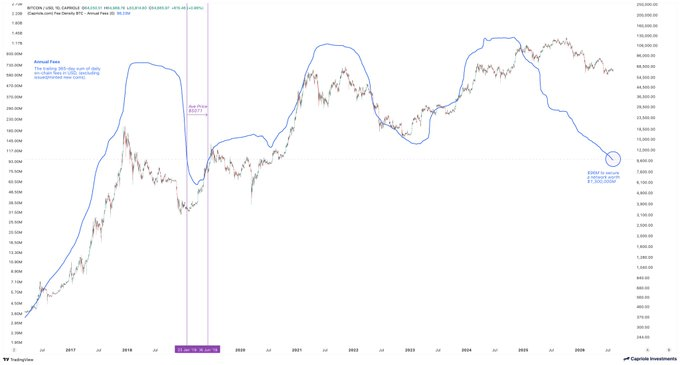
The data also shows subdued on-chain activity compared with the strong network usage recorded during the 2017 and 2021 bull markets. Edwards said the trend helps explain why some miners are moving toward AI-related computing infrastructure while raising questions about Bitcoin network security if the pattern continues.
FAQs
AI data centers use water directly for cooling systems and indirectly through the electricity generation needed to power their computing infrastructure.
Future expansion may depend on transparent water reporting, efficient cooling technologies, and access to sustainable energy resources.
Both industries process large volumes of computational workloads, requiring high-performance computing facilities supported by substantial electricity, cooling systems, and related infrastructure.
Related: Quantum Sells 1,000 ETH to Expand AI Data Center Plans
Disclaimer: The information presented in this article is for informational and educational purposes only. The article does not constitute financial advice or advice of any kind. Coin Edition is not responsible for any losses incurred as a result of the utilization of content, products, or services mentioned. Readers are advised to exercise caution before taking any action related to the company.