

- U.S. margin debt hit a record $1.42 trillion after rising $112 billion in May.
- Real margin debt growth since 1997 reached 550%, outpacing the S&P 500.
- Previous margin debt peaks in 2000, 2007, and 2021 aligned with market highs.
Investor margin debt in U.S. financial markets surged to a new record in May, reflecting increased use of leverage as stock prices continued to approach historic highs. According to the data, margin debt rose by $112 billion during the month to reach $1.42 trillion, marking the second consecutive monthly increase.
Combined with April’s gains, margin debt expanded by $195 billion over two months and has increased by $495 billion, or 54%, over the last year.
Borrowing Growth Outpaces Stock Market Gains
Data compiled by VettaFi indicate that margin debt growth has outpaced the long-term performance of the S&P 500. Since 1997, real margin debt has increased by approximately 550.3%, while the inflation-adjusted S&P 500 has risen about 357.7% over the same period.
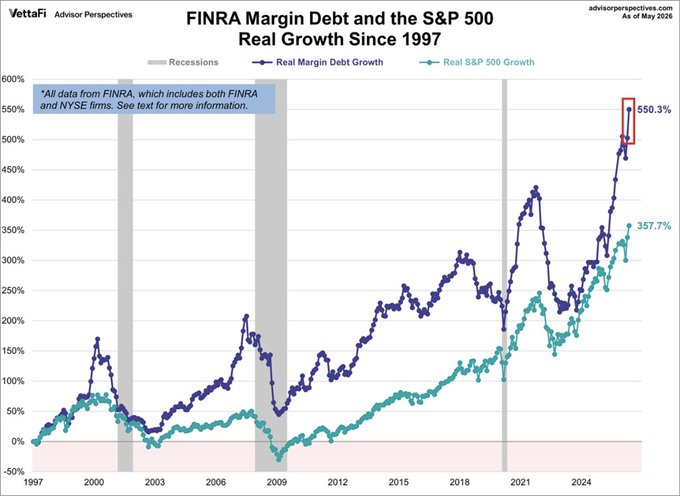
Adjusted for inflation, margin debt advanced 7.9% in May from the previous month and was up by 47.4% from a year earlier.
The latest increase also pushed margin debt above previous highs recorded during earlier market cycles, including the peak reached in 2021. At the same time, the S&P 500 continued climbing, moving above the 7,000 level and reaching new records of its own.
Historical Patterns Around Market Trend Points
Long-term data show that major increases in margin debt have often occurred near key market peaks. During the technology-driven market expansion of the late 1990s, margin debt surged before reaching a peak in March 2000, around the same period the S&P 500 approached its cycle high.
A similar pattern emerged ahead of the global financial crisis. Margin debt rallied throughout 2006 and peaked in July 2007, several months before the stock market reached its high. Following the crisis, borrowing activity fell and bottomed in February 2009, coinciding with the market’s low point.
More recently, margin debt reached a high in October 2021 before declining through 2022. The borrowing cycle later found a low in December 2022, shortly after the broader market downturn.
While rising margin debt often reflects investor confidence and strong market momentum, historical trends show that rapid increases in leverage have frequently preceded periods of heightened volatility. With margin debt now at a record high and stock indexes continuing to set new highs, investors will be watching closely to see whether borrowing continues to support the rally or becomes a source of risk if market conditions change.
Related: Peter Schiff Warns U.S. Debt Could Hit $50T During Trump’s Presidency
Disclaimer: The information presented in this article is for informational and educational purposes only. The article does not constitute financial advice or advice of any kind. Coin Edition is not responsible for any losses incurred as a result of the utilization of content, products, or services mentioned. Readers are advised to exercise caution before taking any action related to the company.