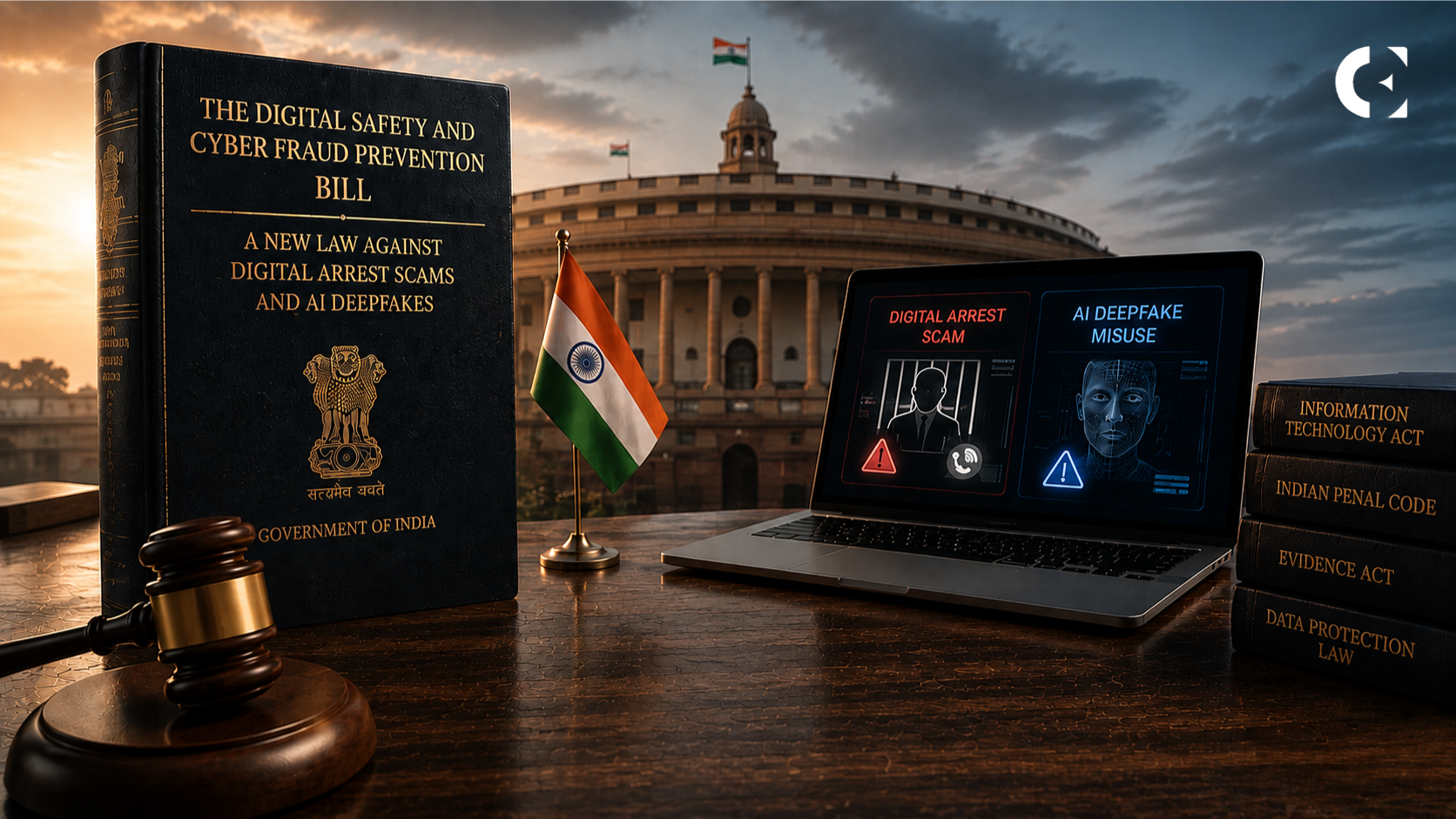

India is considering a new law that would define “digital arrest” scams and harmful AI deepfakes as separate crimes. The move follows the Supreme Court’s concern that current laws punish parts of these schemes without clearly naming either activity as a standalone offense.
Solicitor General Tushar Mehta told the court on July 28, 2026, that a draft bill was being prepared. He said it could cover digital arrests, deepfakes, and other online crimes. The measure might reach Parliament during the Monsoon Session.
Why Is India Planning This Bill Now?
The proposal follows months of judicial pressure. The Supreme Court opened a case in October 2025 after a senior couple reported that criminals had used forged court orders while posing as investigators and judicial officials.
The couple said they were coerced into transferring ₹1.055 crore through several transactions. The court was especially alarmed by forged Supreme Court orders, seals, and signatures used to frighten the victims.
More victims later approached the court, while states reported similar cases. A December order said senior citizens were targeted most often. It also made the CBI the primary agency for digital-arrest investigations.
The NHRC said Indians lost about ₹52,976 crore to all cyber-enabled frauds over six years, with nearly 8% linked to digital arrests. Officials connected the threat to stolen data, mule accounts and Southeast Asian scam compounds.
According to reports, cyber-fraud losses reached ₹22,845.73 crore in 2024, up 206% from 2023. It also cited about ₹3,000 crore extorted through digital arrests. The NHRC separately noted more than 3,000 elderly-targeting cases in the previous year.
During the July hearing, judges said these schemes may involve extortion and robbery. Yet only Parliament can create a new offense. The draft is therefore a possible legislative response, not a crime created by the court.
Impact of AI Deepfakes in India
India’s amended IT Rules define synthetically generated information as realistic artificial or altered audio, images, or video. This includes qualifying deepfakes and cloned voices.
Normal editing is not automatically covered. Color correction, compression, captions, and noise reduction are excluded when they do not distort the substance or meaning of the original material.
MeitY lists misinformation, identity fraud, non-consensual intimate images, sexual exploitation, extortion, and reputational damage among the risks. A copied face or voice can give a false message the appearance of trust.
The RBI warned in November 2024 about fake videos showing its then governor promoting investment schemes. It said RBI officials did not support such offers or give that advice.
Deepfakes can also cause reputational harm. On July 27, 2026, the Bombay High Court allowed Union Minister Nitin Gadkari to pursue a civil case over allegedly defamatory deepfakes and posts linked to the E20 fuel programme.
Meanwhile, the 2026 IT Rules amendment took effect on February 20. Covered intermediaries must act against unlawful synthetic material. They must ensure permitted synthetic content has a clear label and, where technically feasible, embedded metadata or another provenance tool.
These rules mainly regulate platforms and do not establish a general deepfake offense. A valid court order or authorized government notice starts a three-hour removal deadline. Certain impersonation, morphed, or intimate-content complaints have a two-hour limit.
What Is the Relation to Crypto?
The reported proposal is not a crypto-regulation bill. Digital assets become relevant when fraud groups convert stolen rupees into cryptocurrencies or stablecoins. In the cited ED cases, victims first sent money to bank accounts controlled by others.
In a Surat investigation, the ED alleged that a network generated ₹104.15 crore from several cyber frauds. Funds entered hired bank accounts, passed through other accounts, and became cash. Hawala operators then converted part of it into crypto or USDT.
Another case involved industrialist S.P. Oswal. Fake CBI officers allegedly extorted ₹7 crore, while related proceeds moved through more than 200 mule accounts. One accused received his share in USDT and rupees, the ED said.
India placed virtual-asset service providers under anti-money-laundering rules in March 2023. Covered Indian and offshore companies serving the country must register with FIU-IND, keep records, and report suspicious activity. These duties help investigators follow transfers into compliant exchanges.
How Would Asset-Freezing Provisions Work?
The Supreme Court suggested freezing an accused person’s assets after a prima facie case is supported by reasoned material. This is not yet a provision of the proposed law. The unpublished draft may adopt, alter or omit it.
The Supreme Court’s December directions allowed the CBI and state police to freeze amounts initially traceable to reported cybercrime, with or without an FIR in appropriate cases. This can stop rapid transfers.
Sections 106 and 107 of the Bharatiya Nagarik Suraksha Sanhita provide another route. Police can seize suspected crime-linked property and report it to a magistrate. An investigator may also request an attachment with senior police approval.
The affected person normally gets 14 days to oppose attachment. A court or magistrate may issue a temporary order without notice if warning the holder could defeat the action. That exception helps prevent assets from disappearing.
Confirmed crime proceeds may be distributed among affected people within 60 days of the relevant order reaching the district magistrate. A temporary freeze is protective. It does not itself prove that every account holder knowingly joined the offense.
What Rules Already Cover These Scams?
The Bharatiya Nyaya Sanhita already covers much of this conduct. Depending on the evidence, charges may involve cheating, personation, extortion, intimidation, wrongful confinement, conspiracy, or forgery. Several BNS sections appeared in the first Supreme Court complaint.
The Information Technology Act adds computer-related offenses. Section 66C addresses identity theft, while Section 66D covers cheating by personation. Other sections may apply to privacy violations or unlawful sexual material when those facts are present.
The gap is therefore not a total absence of law. It is the lack of offenses expressly named “digital arrest” and “deepfake.” Any benefit from separate definitions cannot be judged until the government publishes the bill.
How Do Deepfakes Enable Crypto Fraud?
Deepfakes can place a trusted face or voice inside a false investment promotion. An official, actor, or business leader may appear to support a token or trading service. MeitY lists fake celebrity investment endorsements as deceptive synthetic content.
The promotion may direct viewers to a fake website, group, or trading app. It can show invented profits before blocking withdrawals or demanding added deposits, taxes, and release fees. The Supreme Court has described similar investment-fraud methods.
Crypto payments are usually difficult to reverse. Yet blockchain transfers are not automatically invisible because wallet addresses and transaction details may be public. Investigators may connect those records to users when funds enter an exchange with customer checks.
How Do Digital Arrest Scams Work in India?
A common operation begins with an unexpected call. The caller claims that a parcel, phone number, identity record, or bank account is linked to drugs, money laundering, or another crime. The victim then reaches a supposed investigator.
That person may claim to represent police, the CBI, ED, customs, narcotics authorities, or RBI. Criminals display uniforms, logos, forged warrants, and false court orders. The Surat group even used a fake police-station set.
Fear and isolation then drive the payment. Victims may be ordered to stay on video, avoid relatives, and keep the case secret. Scammers demand money for verification, bail, penalties, or transfer to a “safe account.”
After payment, funds move through mule accounts held in other names. It can be divided, withdrawn, sent via hawala, or converted into crypto. Each extra layer can make tracing and recovery harder.
The Supreme Court asked the RBI to consider AI and machine learning for finding mule accounts. By February 2026, the government said ₹8,189 crore out of about ₹20,000 crore in cyber-fraud funds had been frozen or returned.
There is no lawful process called a digital arrest. Government agencies do not hold citizens on phone or video calls, and they do not demand payments to safe accounts. A target should disconnect rather than follow instructions.
The incident should be reported immediately through helpline 1930 or the National Cybercrime Reporting Portal. Speed gives banks and investigators a better chance to hold the money before it moves again, although recovery is never guaranteed.
A separate law could create clearer charges and recovery tools. Its success would still depend on fast complaints, bank support, platform evidence, trained investigators, and action against overseas scam centers.
Related: India’s ITR Season Creates a New Cyber Risk as Crypto Profits Meet Refund Scams
Disclaimer: The information presented in this article is for informational and educational purposes only. The article does not constitute financial advice or advice of any kind. Coin Edition is not responsible for any losses incurred as a result of the utilization of content, products, or services mentioned. Readers are advised to exercise caution before taking any action related to the company.