

- BlackRock links Bitcoin’s 53% crash to heavy deleveraging, not a change in its thesis.
- Bitcoin ETF outflows and AI fund inflows added selling pressure after the October peak.
- BlackRock still views Bitcoin as a diversifier, while sharp volatility remains a risk.
Bitcoin price fell more than 50% from its October 2025 record, but BlackRock maintains that the pullback has not altered its long-term investment case. The firm attributes the decline to heavy leverage, forced liquidations, weaker fund flows, and shifting market liquidity.
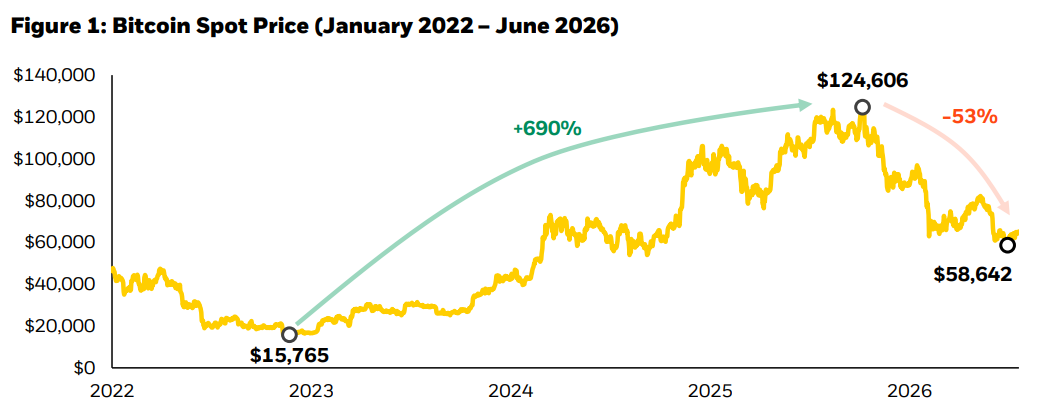
BTC reached $124,606 after a roughly 690% rise from its late-2022 low. It then dropped to $58,642 in early June 2026, marking a 53% peak-to-trough decline. BlackRock calls the move a positioning correction rather than a change in Bitcoin’s investment thesis.
Source: BlackRock
Heavy Leverage Set Up the Bitcoin Crash
Futures open interest climbed above $90 billion in early October 2025 as Bitcoin traded above $120,000. Around 80% of that exposure came from perpetual futures outside CME.
BlackRock says some venues offered 50x to 125x leverage. That left heavily leveraged long positions with little room before exchanges automatically liquidated them.
The pressure surfaced on Oct. 10, 2025. New U.S. tariffs on China drove a broader sell-off, while Bitcoin fell 6% and Ether dropped 11%. Bitcoin futures open interest then fell by $20 billion in one day.
BlackRock described that reduction as the largest single-day open-interest decline on record. Equities recovered later in October, but crypto remained under pressure. Further liquidation waves arrived in February and June 2026.
That sequence pushed Bitcoin below $60,000. It also showed that growing institutional access can coexist with derivatives-driven drawdowns. BlackRock therefore treats deleveraging as a central cause of the crash.
Slower Fund Flows Extended the Weakness
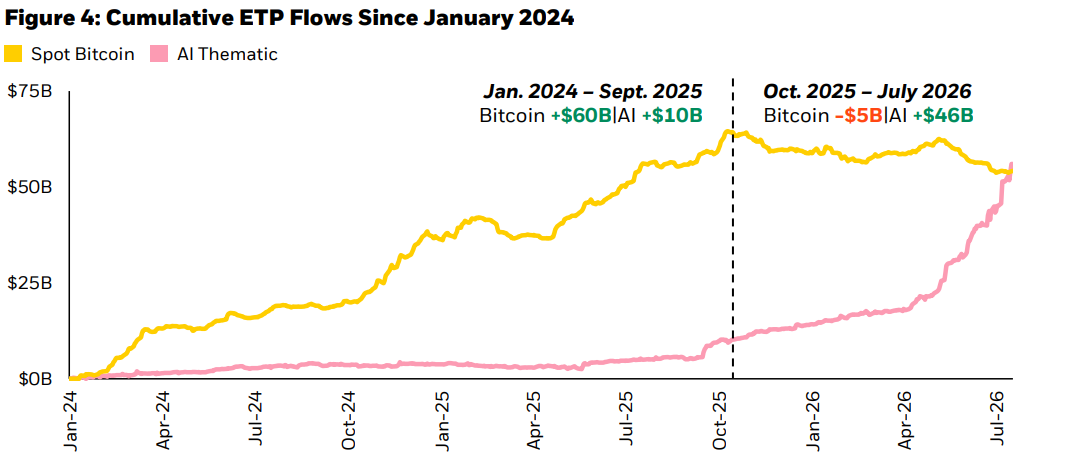
Leverage explains the speed of the initial decline, but flows help explain why weakness lasted. Spot Bitcoin ETPs attracted about $60 billion between their January 2024 U.S. launch and October 2025.
After the peak, Bitcoin funds recorded about $5 billion in aggregate outflows through July 2026. The reversal removed part of the institutional demand that had supported the earlier advance.
Capital also rotated toward artificial intelligence. Figure 4 of BlackRock’s report shows AI-themed funds taking in more than $46 billion from October 2025 through July 2026. BlackRock says that rotation likely competed with Bitcoin for capital.
Source: BlackRock
Digital asset treasury companies added another concern. BlackRock notes skepticism around continued accumulation and balance-sheet sustainability at firms that buy crypto through equity and credit issuance.
How BlackRock Views Bitcoin After a 50% Crash
That distinction matters for investors weighing whether Bitcoin’s 50% decline has created an attractive opportunity. BlackRock does not identify a price target, entry point, or market bottom. Instead, its research examines Bitcoin’s potential role in portfolio construction.
The firm tested small Bitcoin allocations inside a traditional U.S. 60/40 portfolio over the 10 years ending May 29, 2026. A 1% equity-funded Bitcoin allocation produced a hypothetical Sharpe ratio of 0.90, while a 2% allocation produced 0.96.
The benchmark recorded a Sharpe ratio of 0.81. Maximum drawdowns reached 20.6% for the 1% Bitcoin portfolio and 20.9% for the 2% version, compared with 20.3% for the benchmark.
BlackRock stresses that the results are hypothetical. It says allocation size should reflect investor objectives, risk tolerance, and regulatory limits. Its disclosures also warn about extreme volatility and possible principal loss.
Diversification Still Depends on the Time Frame
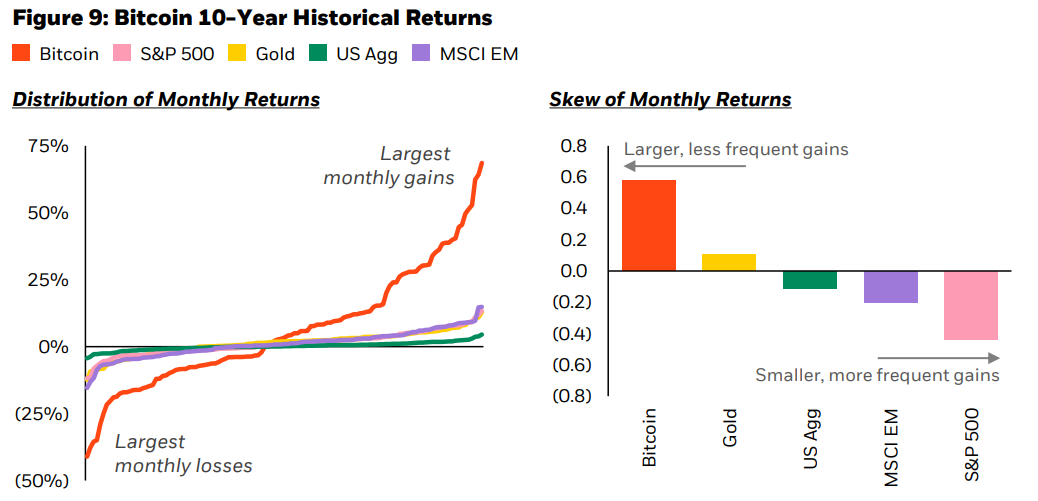
Bitcoin’s role as a portfolio diversifier becomes less clear when it trades like a risk asset during market stress. BlackRock’s 10-year data show Bitcoin had a 0.18 correlation with the S&P 500 as of June 30, 2026.
Source: BlackRock
That was above gold’s 0.06 correlation but below emerging-market equities at 0.57 and U.S. high-yield bonds at 0.69. BlackRock therefore says Bitcoin retained distinct portfolio characteristics over longer horizons.
Shorter periods look less stable. Bitcoin’s correlation with equities rose during the Federal Reserve tightening cycle in 2022 and the 2025 tariff shock. BlackRock calls these episodes part of Bitcoin’s “dual personality.”
Another Sharp Correction Is Still Possible
Lower positioning gives the market a cleaner starting point, but it does not remove volatility. BlackRock says perpetual-futures funding rates briefly turned negative in the second quarter, showing speculative positioning had reset meaningfully lower.
Even so, the firm expects acute volatility episodes to continue. Bitcoin’s market structure has matured through ETPs, regulated futures, and options, but leveraged perpetual futures still expose the market to forced-liquidation cycles.
BlackRock notes that annualized Bitcoin volatility has fallen from regular spikes above 100% a decade ago to below 50% during much of the past two to three years. Sharp market dislocations are still expected to occur.
What Investors Should Watch for Bitcoin’s Next Move
However, a rapid increase in futures open interest and elevated perpetual funding would show speculative exposure rebuilding. BlackRock links high positioning with stronger risk-asset correlation during later deleveraging.
Institutional flows provide a second test. Farside Investors recorded $297.5 million of net U.S. spot Bitcoin ETF inflows on Aug. 17 and $45.7 million on Aug. 18. Those gains followed outflows on Aug. 13 and Aug. 14.
Liquidity is another factor. BlackRock highlighted that Bitcoin returns broadly tracked changes in global money supply over the past decade. That relationship weakened after October even as M2 expanded, as Bitcoin-specific selling dominated the near-term backdrop.
However, BlackRock expects Bitcoin’s elevated correlation with risk assets to ease after deleveraging. A sustained decline in that correlation would support its long-term diversification case.
BlackRock’s outlook supports Bitcoin’s long-term role rather than a near-term buy signal. The more than 50% pullback has not altered its case as a monetary alternative and portfolio diversifier. Lower leverage, improving fund flows and supportive liquidity would provide a stronger backdrop for recovery.
Related: Citi to Launch Bitcoin Custody Service Through New Custody+ Platform
Disclaimer: The information presented in this article is for informational and educational purposes only. The article does not constitute financial advice or advice of any kind. Coin Edition is not responsible for any losses incurred as a result of the utilization of content, products, or services mentioned. Readers are advised to exercise caution before taking any action related to the company.