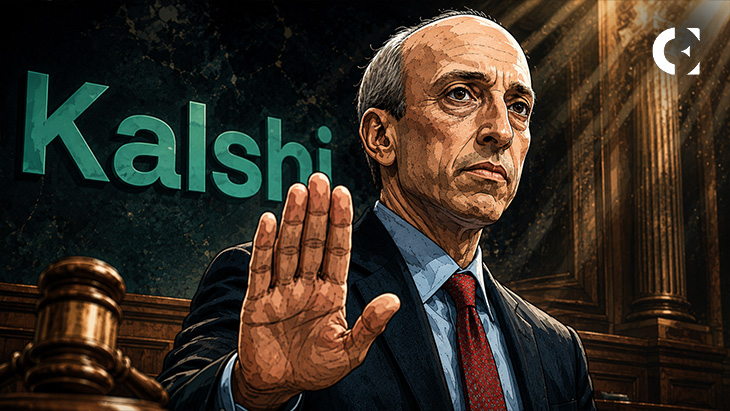

- Gary Gensler backed amicus briefs arguing that Kalshi’s sports markets violate state laws.
- The case could move sports betting oversight from states to the CFTC alone.
- Gensler argued Congress never intended CFTC oversight to replace state sports betting laws.
Former CFTC and SEC Chairman Gary Gensler joined the Indian Gaming Association, Native American tribal organizations, the American Gaming Association, and Better Markets in filing amicus briefs with the Sixth Circuit Court of Appeals on Thursday, all arguing that prediction market platform Kalshi’s sports-related contracts violate state gaming regulations and cannot preempt state law.
The case stems from a lawsuit Kalshi filed against Ohio to block the state from taking action against it. A federal judge ruled against Kalshi in March, and the platform is now appealing that decision.
What Is at Stake
Kalshi argues that Dodd-Frank gave the CFTC nationwide authority over sports betting contracts by classifying certain event contracts as swaps, effectively overriding state gaming laws across the country. If that argument succeeds, it would shift regulatory authority over a $165 billion annual industry from state gaming commissions to a single federal regulator.
Gensler’s Position
Gensler served as CFTC Chairman from 2009 to 2014 and helped draft Dodd-Frank. He testified before Congress 54 times as chairman without sports betting ever arising as a topic. Dodd-Frank was written to address the unregulated derivatives market that contributed to the 2008 financial crisis. Sports betting had no connection to that crisis, and no participant in the drafting process ever raised the CFTC as a national sports betting regulator.
Gensler also pointed to a practical absurdity in Kalshi’s reading. If sports bets were legally swaps under Dodd-Frank, every off-exchange retail sports wager placed in the United States since October 2012 would have been illegal. The Supreme Court examined sports betting law in detail in Murphy v. NCAA in 2018, and nobody raised that argument.
Gensler’s brief said, “To put the argument in the plainest real-world terms: Senate Majority Leader Harry Reid of Nevada would never have consented to or passively accepted legislation displacing an activity so critical to his state’s economy and politics by permitting sports betting only under CFTC auspices.”
The Broader Opposition
Native American tribal organizations and the American Gaming Association represent billions of dollars in licensed gaming revenue operating under state regulatory frameworks that Kalshi’s legal theory would dismantle.
Better Markets, a financial reform advocacy group, argued the CFTC lacks both the expertise and resources Congress would have provided if it had intended to make the agency a national sports betting regulator.
The CFTC under current Chairman Michael Selig supports Kalshi’s position, placing the current agency directly against its former chairman and a coalition of established gaming interests in a case that will define the boundary between federal commodity regulation and state gaming authority.
Related: Michael Selig Is Reshaping U.S. Crypto Policy as Sole CFTC Commissioner
Disclaimer: The information presented in this article is for informational and educational purposes only. The article does not constitute financial advice or advice of any kind. Coin Edition is not responsible for any losses incurred as a result of the utilization of content, products, or services mentioned. Readers are advised to exercise caution before taking any action related to the company.