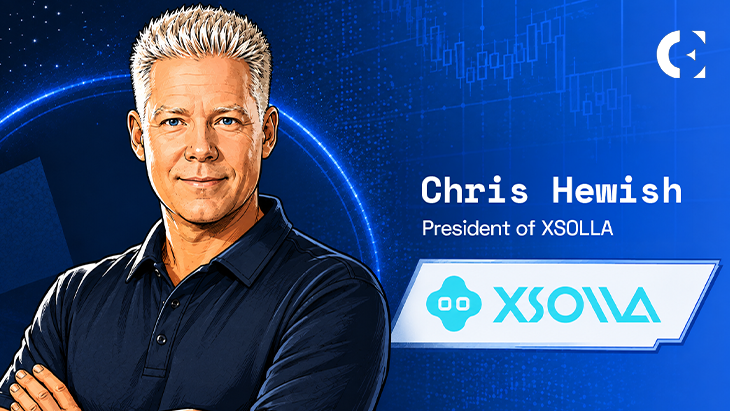

The President of Xsolla visited the CoinEdition team and spoke about how real ownership in the web3 games would feel like. Xsolla is built to help game developers build, launch, and grow their businesses independently in an industry that is constantly reinventing itself. Over the past three decades, Chris Hewish worked across some of gaming’s biggest technology shifts, from the rise of console publishing at Activision, to mobile and transmedia at DreamWorks Animation, to VR at Survios and Skydance, and now Web3 commerce and direct-to-consumer infrastructure at Xsolla.
His focus was always to build practical systems that empower developers and players rather than locking them into closed ecosystems. Helping creators turn emerging technologies into sustainable businesses has been his core part.
Q1. The OG crypto revolutionary mindset, what made you say that?
What I said at Consensus came from a real frustration with complacency. The original promise of crypto was radical: disintermediation, user ownership, freedom from centralized control. But somewhere along the way, a lot of the ecosystem got comfortable with the existing platforms, comfortable with the same gatekeepers, just with a blockchain wrapper on top. What I was challenging the audience to remember is that the revolutionary posture wasn’t just about technology. It was about demanding something fundamentally different. Privacy is a perfect example of that. Gamers have handed over enormous amounts of behavioral and financial data to platforms that monetize it without meaningful consent or transparency. The people who built this industry on the idea of decentralization should be the loudest voices demanding better. If you’ve lost that edge, if you’re more focused on the next funding round than on whether players actually own what they earn, you’ve drifted from what made this movement worth fighting for.
Q2. The CLARITY Act: How does it specifically benefit Web3 gaming?
The CLARITY Act is genuinely consequential for our sector, and I don’t say that lightly. What’s been happening for the last several years is that regulatory ambiguity in the U.S. has been pushing innovation offshore. Developers who want to build token economies, in-game asset ownership systems, or peer-to-peer player markets have faced a fundamental question: Is this a security? Nobody has been able to answer that definitively, and the cost of being wrong is catastrophic. So studios have moved to the UAE, to Europe, to Singapore, and American jobs and capital have followed. The CLARITY Act draws a clear line between the SEC and CFTC’s jurisdiction over digital assets. It creates compliant pathways for the kinds of decentralized systems that power game economies. It legally recognizes that not every token is a financial instrument. For Web3 gaming specifically, that’s the unlock. You can’t build a player-owned economy if you can’t operate legally in the world’s largest gaming market. This bill doesn’t solve everything, but it gives developers a foundation to build on.
Q3. Should gaming be included in digital asset policy conversations?
Absolutely, and the fact that it often isn’t is a real problem. Most of the debate over the CLARITY Act has centered on institutional investors, stablecoin issuers, and major exchanges. Those are legitimate concerns. But gaming is the largest digital asset use case that nobody in Washington is talking about. There are billions of players worldwide who already participate in digital economies, buying items, earning in-game currency, and trading assets without ever thinking of themselves as crypto users. The behavioral infrastructure for Web3 adoption already exists in games. When policy gets made without gaming at the table, you end up with frameworks that treat a cosmetic item in a game the same as a financial derivative. That’s not just technically wrong, it actively chills innovation in one of the most economically significant entertainment sectors in the world. Xsolla submitted formal recommendations to the Senate specifically to make this case, and I’d encourage every major studio and platform to do the same. If we’re not in the room, the rules will get written without us.
Q4. Why do player ownership, self-custody, and peer-to-peer transfers matter?
Because the alternative is a system that’s fundamentally dishonest with players. Right now, when a player buys a skin, earns a rare item, or builds up inventory in a game over years of play, they own nothing. The publisher can shut down the servers tomorrow, and that value disappears. The platform can change the terms of service, and that item is gone. That’s not ownership; it’s a license, and a revocable one. Self-custody and peer-to-peer transfers change the power dynamic. They mean a player’s time, investment, and contribution to an ecosystem has real, portable value. Not speculative value earned value. I’ve spent nearly three decades in this industry, and what I’ve consistently seen is that the games with the deepest, most loyal communities are the ones where players feel they have a real stake. Web3 infrastructure makes that stake literal. That matters economically, but it also matters for the kind of relationship developers can build with their players.
Q5. Future outlook: how will people perceive Web3 games?
The narrative is already shifting, and I think it shifts decisively over the next three to five years. The early wave of Web3 games made a critical mistake: they led with the financial mechanics and treated gameplay as secondary. That’s backward, and players saw through it immediately. What’s coming next is a generation of games where blockchain infrastructure is essentially invisible to the player; it’s just how ownership and value transfer work under the hood. You play because the game is great. The ownership layer is a feature, not the product. When that’s the experience, the perception problem goes away. I also think we’ll see participation economies, where players earn through actual contribution rather than speculation, become a standard model rather than an experiment. The studios that figure that out early will have a structural advantage in player acquisition, retention, and community building that legacy publishers won’t be able to replicate quickly. The future of Web3 gaming isn’t a niche; it’s the mainstream model for how games are built and monetized.
Q6. Gaming tokens as investments, your comment?
I’ll be direct: I’m not an investment advisor, and I’m not going to tell anyone what to do with their money. What I will say is that the framing of gaming tokens primarily as investment vehicles concerns me, because it conflates two very different things. Tokens that represent participation in a game economy, earning through play, contributing to a community, and building skills that have real underlying utility. Tokens that are marketed primarily as financial instruments, with gameplay as a secondary consideration, have a very different risk profile and a history of not ending well for retail participants. My focus at Xsolla is on the infrastructure that supports the former building systems, where value flows from genuine participation rather than speculation. The regulatory clarity we’re advocating for through the CLARITY Act is partly about drawing exactly that distinction. When the legal framework catches up to the technology, I think you’ll see a much healthier ecosystem where players and investors alike have better information to make decisions.
Conclusion
As Web3 gaming moves beyond speculation and hype, industry leaders like Chris Hewish believe the future will be defined by practical ownership, transparent economies, and player-first ecosystems. From advocating for regulatory clarity through the CLARITY Act to pushing for self-custody and peer-to-peer asset transfers, Hewish’s vision reflects a broader shift in gaming. For Xsolla, the goal is not simply to build Web3 games, but to create sustainable systems where developers retain independence and players gain meaningful ownership over their digital experiences.
Disclaimer: The information presented in this article is for informational and educational purposes only. The article does not constitute financial advice or advice of any kind. Coin Edition is not responsible for any losses incurred as a result of the utilization of content, products, or services mentioned. Readers are advised to exercise caution before taking any action related to the company.